The star left by the supernova of 1181 sits dead center, and that rules out a big kick
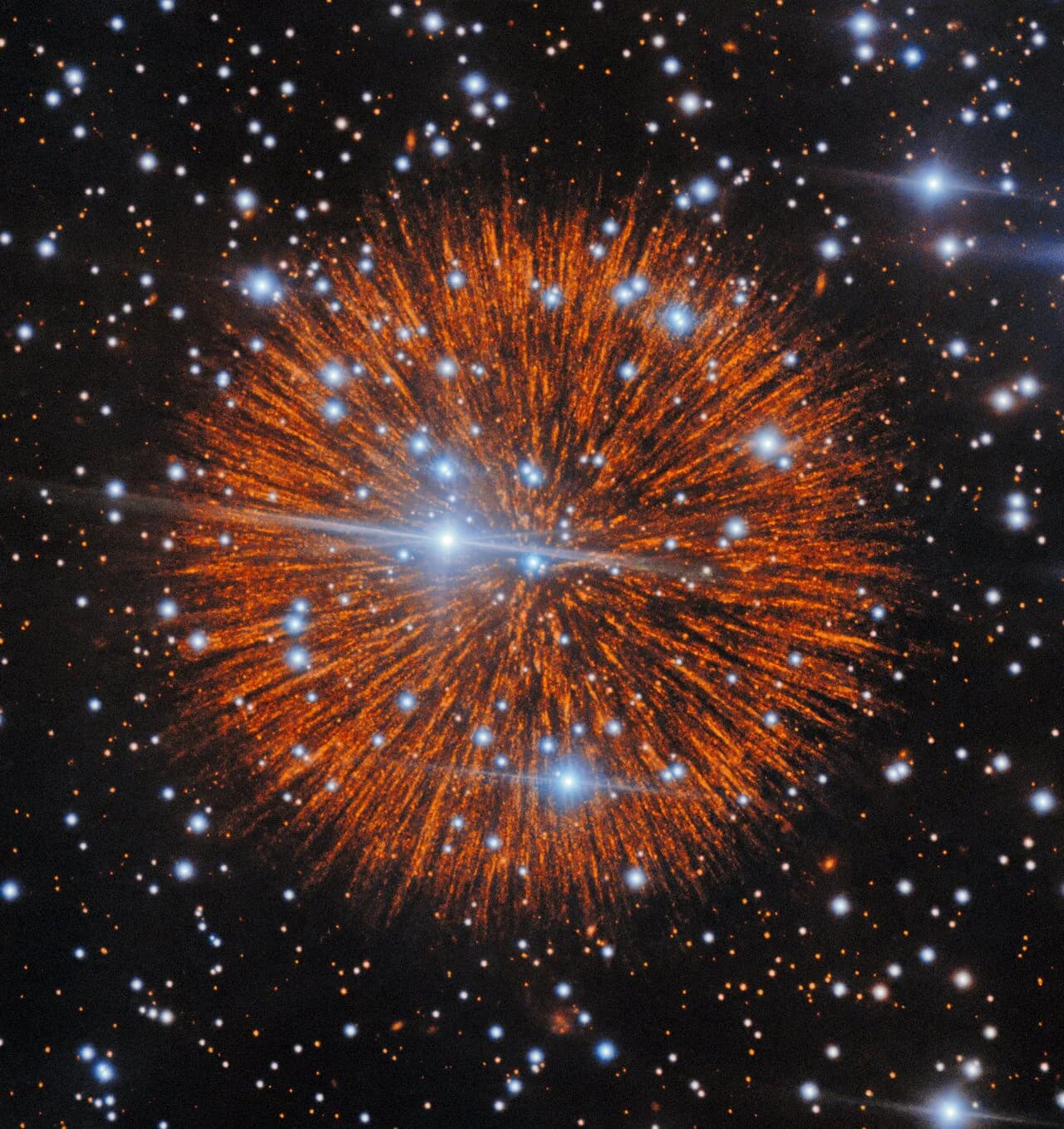
New Gemini North images of Pa 30 show its firework streaks are chains of knots, and the survivor star's position says the explosion was unusually even.
OddBrief EditorialAI-assisted, human-reviewed
 Science
Key facts
- Object
- Pa 30, likely remnant of supernova SN 1181, about 7,500 light-years away
- Finding
- filaments are chains of gas knots; about ten times more structure than seen before
- Clue
- the surviving star sits almost exactly at the center, so no large kick
- Paper
- published October 6, 2026 in The Astrophysical Journal
The remnant of the supernova that astronomers in China, Japan and the Arab world recorded in August 1181 has a surprise at its center. New Gemini North observations of the nebula Pa 30 show its surviving star sitting almost exactly in the middle, which the team says means the explosion gave it no large kick, according to NSF NOIRLab.
The same images show that Pa 30's famous radial streaks are not smooth. They are strings of small gas knots, each big enough to hold ten times the orbit of Neptune. The work appears in The Astrophysical Journal.
A star that should have been thrown off course
Stars that survive a supernova are expected to be flung away by the blast. Pa 30's central star, IRAS 00500+6713, has not moved off center. Ilaria Caiazzo of the Institute of Science and Technology Austria, who co-led the analysis, put the logic simply: "Explosions conserve momentum." A symmetric explosion leaves symmetric debris and no strong kick to the survivor.
From that, the researchers conclude that SN 1181 was a Type Iax supernova. Unlike standard Type Ia blasts, which destroy the white dwarf entirely, Iax events are weaker, incomplete explosions that leave a star behind. No other remnant of this type has been identified in our galaxy, and one proposed origin is a merger of two white dwarfs.
The leftover star is extreme. NOIRLab puts its temperature at about 200,000°C and its stellar wind at around 16,000 kilometers per second.
Ten times more structure than before
The team, led by Tim Cunningham of the Center for Astrophysics, Harvard & Smithsonian, and Caiazzo, used the GMOS spectrograph to map emission from ionized sulfur and oxygen. The sulfur data revealed about ten times as many filaments as earlier images could separate. The knots along them are remarkably similar in size.
That regularity points to thermal or density variations in the surrounding gas, which may have shaped the debris as it flew outward, the researchers suggest.
Found by an amateur only in 2013
For a remnant of one of only five Milky Way supernovae seen before the telescope, Pa 30 was found late. It turned up in 2013 in a citizen science search of WISE infrared data, the 30th nebula logged by amateur astronomer Dana Patchick, hence the name. Eight historical texts describe the 1181 "guest star", which stayed visible in Cassiopeia for 185 days.
Pa 30 lies about 7,500 light-years away. What produced the knots, and whether the double white dwarf merger idea holds, are the questions the new data leaves open.
Sources
- Gemini North Reveals Pearl-Like Knots in the Remnant of a Supernova Witnessed in the Year 1181NSF NOIRLabprimary source
- International team of astronomers detect striking new details in unique supernova remnantInstitute of Science and Technology Austria via EurekAlert
- Detection of knots in the supernova type Iax remnant Pa 30The Astrophysical Journal