Hubble's 1999 white dwarf data hid niobium, the clue to a planet built from a dead star
About 100 unexplained lines in a 27-year-old Hubble spectrum turned out to point to a gas giant made from its own star's leftovers.
OddBrief EditorialAI-assisted, human-reviewed
 Science
Key facts
- Star
- white dwarf HS 0209+0832, first observed by Hubble in 1999
- Clue
- niobium, matching many of about 100 unidentified spectral lines
- Planet
- suspected Jupiter-sized gas giant on a 4.4-day orbit, about 6 million km out
- Paper
- Nature Astronomy, October 5, 2026, led by the University of Warwick
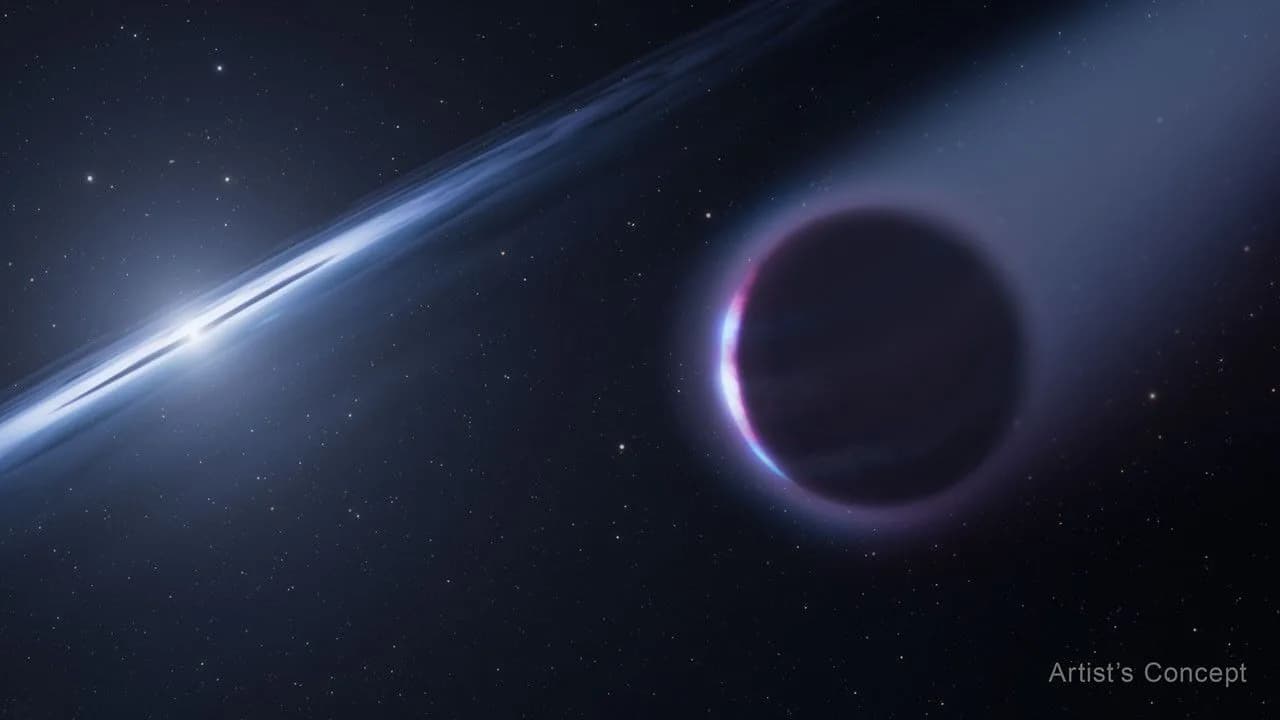
A Hubble spectrum taken in 1999 of the white dwarf HS 0209+0832 carried about 100 chemical lines nobody could identify. A University of Warwick team now says many of them come from niobium, and that the element points to a Jupiter-sized planet that formed from material the star shed as it died, according to a study published October 5 in Nature Astronomy.
If the reading holds, it would be a rare example of a second-generation planet: a world assembled after its star's death rather than at its birth. NASA, which operates Hubble, describes the planet as suspected, not confirmed.
The answer was in the archive all along
The puzzle sat unsolved for more than two decades. Jamie Williams, a doctoral student at Warwick, reopened the archived observation armed with a newer catalog of atomic lines, NASA said. Niobium turned out to explain a large share of the unknown features. Data from the retired FUSE ultraviolet telescope showed the same signatures.
An earlier abstract by Williams, presented at the UK's National Astronomy Meeting in July 2025, called this the first detection of niobium in any white dwarf. The star's atmosphere is also low in the usual rock-building elements, silicon and iron, but rich in zinc and copper.
That mix matters because elements heavier than iron are forged inside dying stars. Nicholas Stone of the University of Wisconsin–Madison said the pattern is "a telltale sign of the 's-process'", the nuclear reaction that builds heavy elements while a star swells into a red giant.
Nobody has seen the planet itself
The planet is inferred, not imaged. NASA's TESS satellite watched the white dwarf for four months and recorded a brightness change that repeats about every 4.4 days. The 2025 abstract put the amplitude at about 0.2%.
The team reads that signal as a gas giant orbiting roughly 6 million kilometers (3.7 million miles) from the star. At that distance, according to the abstract, the hot white dwarf's ultraviolet light should strip gas off the planet.
That stripping is also why the chemistry can be read at all. Gas boiled off the planet falls onto the white dwarf, so the star's atmosphere carries a sample of what the planet is made of. The heavy elements in it are the reason the team thinks the planet was built from recycled stellar material rather than surviving from the system's youth.
What would settle it
The study does not include a direct detection of the planet, such as a transit or a measured mass. Until one arrives, the second-generation label rests on the chemistry and a small, regular flicker.
Williams framed the stakes broadly, saying the white dwarf stage may not be an epilogue but the start of "a potentially much longer tale" for planetary systems.
Sources
- Suspected Second-generation Planet Solves NASA Hubble Cold CaseNASAprimary source
- The phoenix planet: astronomers find a world reborn from its star's ashesUniversity of Warwick via EurekAlert
- A second generation planet accreted by a white dwarf?National Astronomy Meeting 2025