Crew-13 reached the space station in a record 7 hours, 55 minutes
Four astronauts reached the ISS less than eight hours after launch. Their work will range from lab-grown tissue to more autonomous space crops.
OddBrief EditorialAI-assisted, human-reviewed
 Science
Key facts
- Launch
- October 1, 2026, at 11:10 a.m. EDT from Cape Canaveral
- Docking
- 7:05 p.m. EDT after 7 hours and 55 minutes
- Crew
- Jessica Watkins, Luke Delaney, Joshua Kutryk and Sergey Teteryatnikov
- Research
- stem-cell-derived tissues, crop growth and astronaut health
NASA's SpaceX Crew-13 reached the International Space Station on October 1, 2026, just 7 hours and 55 minutes after launching from Florida. NASA called it the fastest launch-to-docking trip by a U.S. spacecraft in the station's history, but the tighter travel schedule is only the start of a mission built around health and food research.
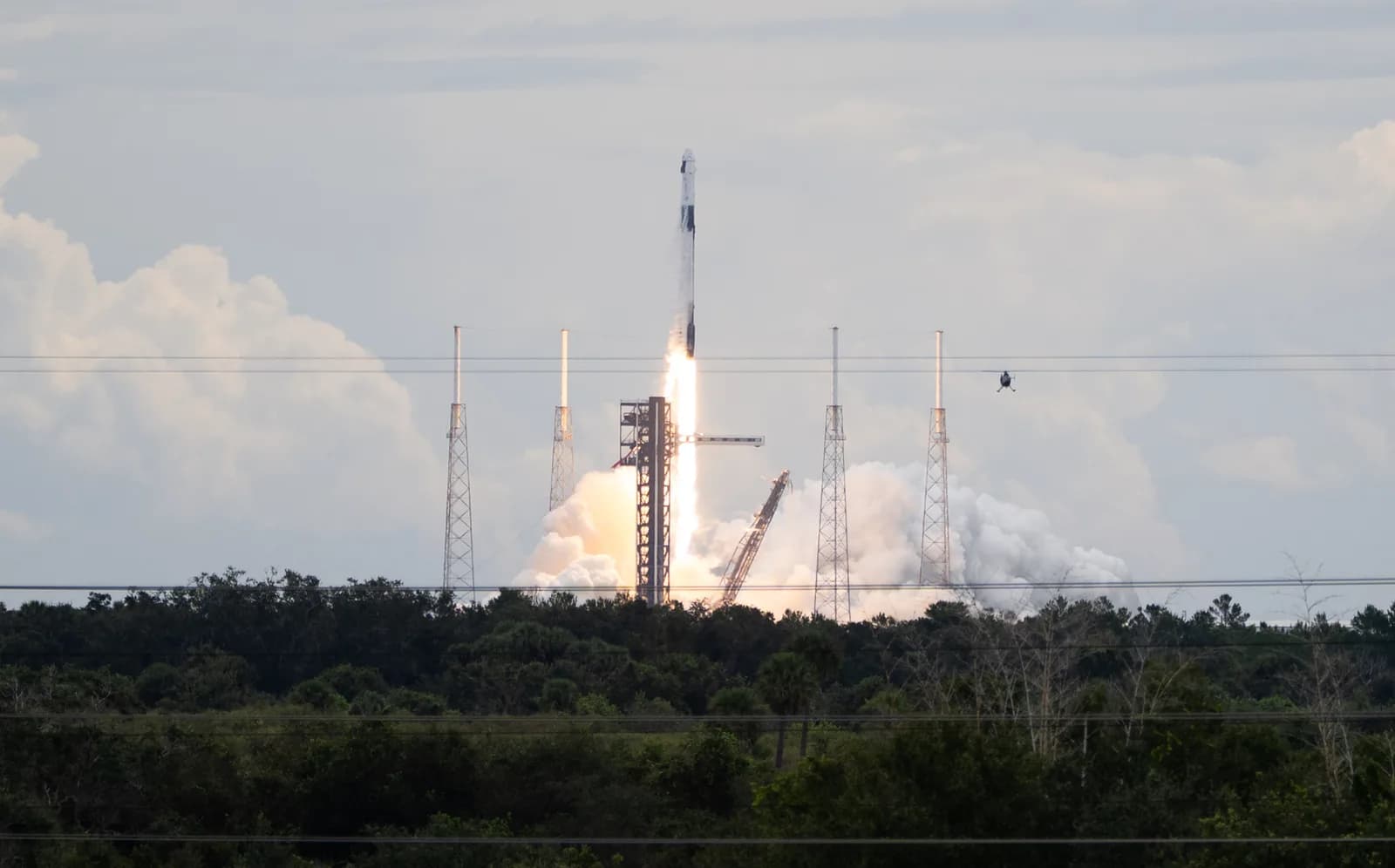
The Falcon 9 lifted off at 11:10 a.m. EDT from Cape Canaveral Space Force Station with NASA astronauts Jessica Watkins and Luke Delaney, Canadian Space Agency astronaut Joshua Kutryk, and Roscosmos cosmonaut Sergey Teteryatnikov aboard Dragon. NASA reported docking at 7:05 p.m. EDT at the station's Harmony module. The crew entered the station after the hatch opened later that evening.
A shorter trip is a milestone, not the mission
The record describes the time between launch and docking, not a new top speed for the spacecraft. Dragon still had to phase its orbit toward the station and make a controlled approach. NASA said the spacecraft's maneuvers were monitored by SpaceX mission control in California while NASA tracked station operations from Houston.
That distinction matters because the scientific work begins after arrival. Crew-13 joins Expedition 75, and the station must also complete a handover with the departing Crew-12 team. A quick docking does not itself tell us whether the experiments will work or how much useful data they will yield.
Tissue and crops share the same laboratory
NASA says the crew will use microgravity to produce tissues derived from human stem cells. The proposed uses include disease models and future drug screening for conditions such as heart disease and Parkinson's disease. Those are research aims, not medical treatments delivered by this flight.
Food production is another focus. The crew plans to install a mostly autonomous plant-growth facility and test crop-growing methods outside a dedicated station plant area. For a future long-duration mission, the practical question is whether a crop system can function with limited crew attention and fit around other station work.
Crew members are also expected to examine factors associated with unusual blood flow in space and test an in-flight diagnostic device. NASA describes these as ways to understand and monitor astronaut health, not as proof that a particular risk has been solved.
What the record does not settle
The rapid transit is an operational achievement for the launch and docking sequence. The more consequential results will come later, when the tissue, plant and health investigations have produced observations that researchers can assess.
NASA has not reported outcomes from those Crew-13 experiments in its launch and arrival updates. For now, the confirmed facts are the four-person arrival, the 7-hour, 55-minute journey, and the research NASA says the crew is scheduled to carry out.
Sources
- NASA’s SpaceX Crew-13 Launches to International Space StationNASAprimary source