NASA's roamx-0201 blade could stretch a Mars helicopter flight from 0.7 km to 18.7 km
A thinner, asymmetric rotor airfoil from NASA Ames could let future Mars helicopters fly far longer in one hop, but NASA says it is not ready for Mars.
OddBrief EditorialAI-assisted, human-reviewed
 Science
Key facts
- Who
- NASA Ames Research Center with Imperial College London and Nagoya University
- What
- the roamx-0201 airfoil, a thinner asymmetric Mars rotor blade
- Estimate
- single-flight range up to 18.7 km with instruments, versus 0.7 km for Ingenuity
- Status
- still experimental, not ready for a Mars mission
A new rotor blade shape tested by NASA could let a future Mars helicopter cover as much as 18.7 kilometres in a single uninterrupted flight while carrying science instruments, compared with 0.7 kilometres for Ingenuity, according to NASA. The design, called roamx-0201, comes from a team at NASA's Ames Research Center working with Imperial College London and Nagoya University.
The range figure comes from high-fidelity simulations, and NASA says plainly that the blade is not Mars-ready.
A thinner, lopsided blade
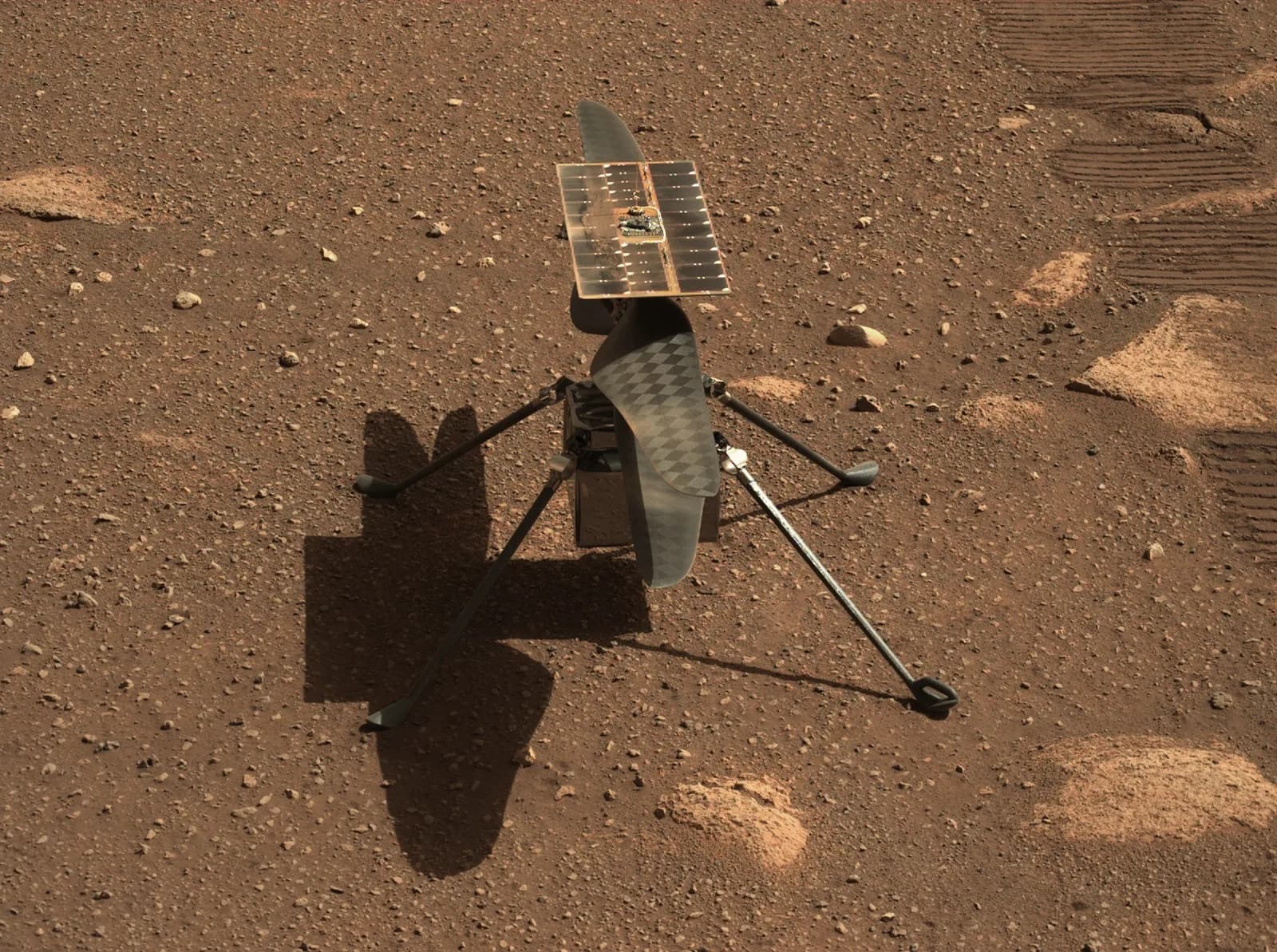
Ingenuity, which made the first powered flight on another world, used a blade designed for Mars' very thin air. The SkyFall mission, scheduled to launch in 2028 with three helicopters, uses a similar blade.
The roamx-0201 airfoil is aimed at missions after SkyFall. Its cross-section was shaped by simulations and optimisation algorithms tuned to Martian conditions, and they pushed the design toward something thinner and asymmetrical. Wind tunnel tests then showed better performance and better recovery in risky flight conditions, NASA said.
The findings were published on September 22 in an AIAA journal, NASA said.
Using turbulence on purpose
Two effects explain most of the gain. The first is "drag divergence," a sudden loss of performance as rotor tips approach the speed of sound. Sound travels more slowly on Mars than on Earth, so the problem arrives sooner there. The new blade can run longer at higher speeds before it hits that wall.
The second is counterintuitive. Air flowing over a blade forms a thin "boundary layer," and the roamx-0201 shape deliberately disturbs it right at the leading edge. According to NASA, that disturbance ends up pulling the blade upward and producing more lift than earlier designs.
The blade also handles stall better. Ingenuity's blades lost performance steeply when the angle of airflow changed, while the new design showed significantly improved stall behaviour under the conditions studied, which could let helicopters fly safely across a wider range of angles.
What still has to be solved
The 18.7 kilometre number is an estimate of what the blade could enable, not a flight result. NASA says the current tests are partly about understanding and fixing gaps between computer predictions and real-world performance, a sign that the models and the wind tunnel do not yet fully agree.
NASA did not give a timeline for when the blade might be ready for a mission.
Sources
- NASA Experimental Mars Helicopter Blade Designs Target Longer FlightsNASAprimary source
- ROAMX project technical reportNASA Technical Reports Server