NASA's Dragonfly flew its first Titan flight on a testbed, and it is the mission's hardest
A real-time simulation at Johns Hopkins APL ran Dragonfly's opening Titan flight on flight-like avionics, with camera views drawn in 20 to 70 milliseconds.
OddBrief EditorialAI-assisted, human-reviewed
 Science
Key facts
- Who
- NASA and the Johns Hopkins Applied Physics Laboratory
- What
- a real-time simulation of Dragonfly's first Titan flight on flight-like avionics
- Detail
- a GPU camera emulator drew each scene in about 20 to 70 milliseconds
- Next
- the same flight on the actual flight system, plus deliberate fault tests
NASA's Dragonfly rotorcraft has flown its first flight on Titan, but only on computer hardware at the Johns Hopkins Applied Physics Laboratory (APL) in Laurel, Maryland. NASA said on October 23 that the real-time run on flight-like avionics was the most complete rehearsal yet of the flight Dragonfly will make when it reaches Saturn's largest moon in 2034.
That opening flight is also its hardest. "The cool thing about first flight is that it's our most challenging flight," said Zach Putnam, the mission's mobility subsystem lead engineer at APL, because it draws on every flight sensor the lander carries.
A Titan rendered in milliseconds
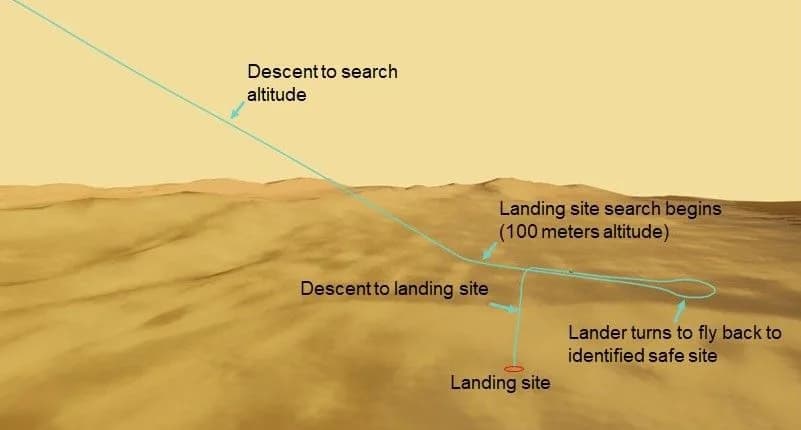
In the simulation, Dragonfly separated from its backshell, sped over Titan's dunes, scanned the ground for a safe landing spot, circled back and began its final descent. The flight software was fed simulated data from the sensors it will rely on at Titan: its recently fitted navigation cameras, its inertial measurement units and a lidar.
Lidar, which Dragonfly will use to measure terrain height and slope and spot hazards, was the last piece the team needed for a full rehearsal. Earlier tests had built up in steps, starting with a single spinning rotor, then a short "reposition" flight and a partial scouting flight.
To feed the cameras, a custom emulator ran on graphics processors and drew every fake Titan view within the 20 to 70 millisecond window that matches the exposure times of Dragonfly's real cameras. That let engineers watch how processes aboard the lander hand data to each other at millisecond scales.
No help from Earth
The next step is to fly the same sequence on Dragonfly's actual flight system rather than a testbed. Engineers also plan other flight profiles and will deliberately inject faults to check that the rotorcraft responds on its own. "Everything we do on Titan has to happen autonomously," Putnam said.
Separately, Lockheed Martin engineers in Colorado are testing the "pose" mechanism that will lower the rotorcraft out of its stowed position inside the backshell before release. The tests include static loads with representative mass and repeated deployments at different tilt angles, to mimic the backshell swinging under its parachute.
The long road to the dunes
Launch is planned for 2028 at the earliest, followed by a six-year cruise, then spend three years hopping between sites to study Titan's chemistry, geology and atmosphere. NASA has not said when the first flight on the real hardware will take place.
Sources
- NASA's Dragonfly Completes First Simulated FlightNASAprimary source
- Dragonfly's first flight concept of operationsThe Planetary Society