Mars's longest cloud forms without dust, at humidity 100,000 times what we live with
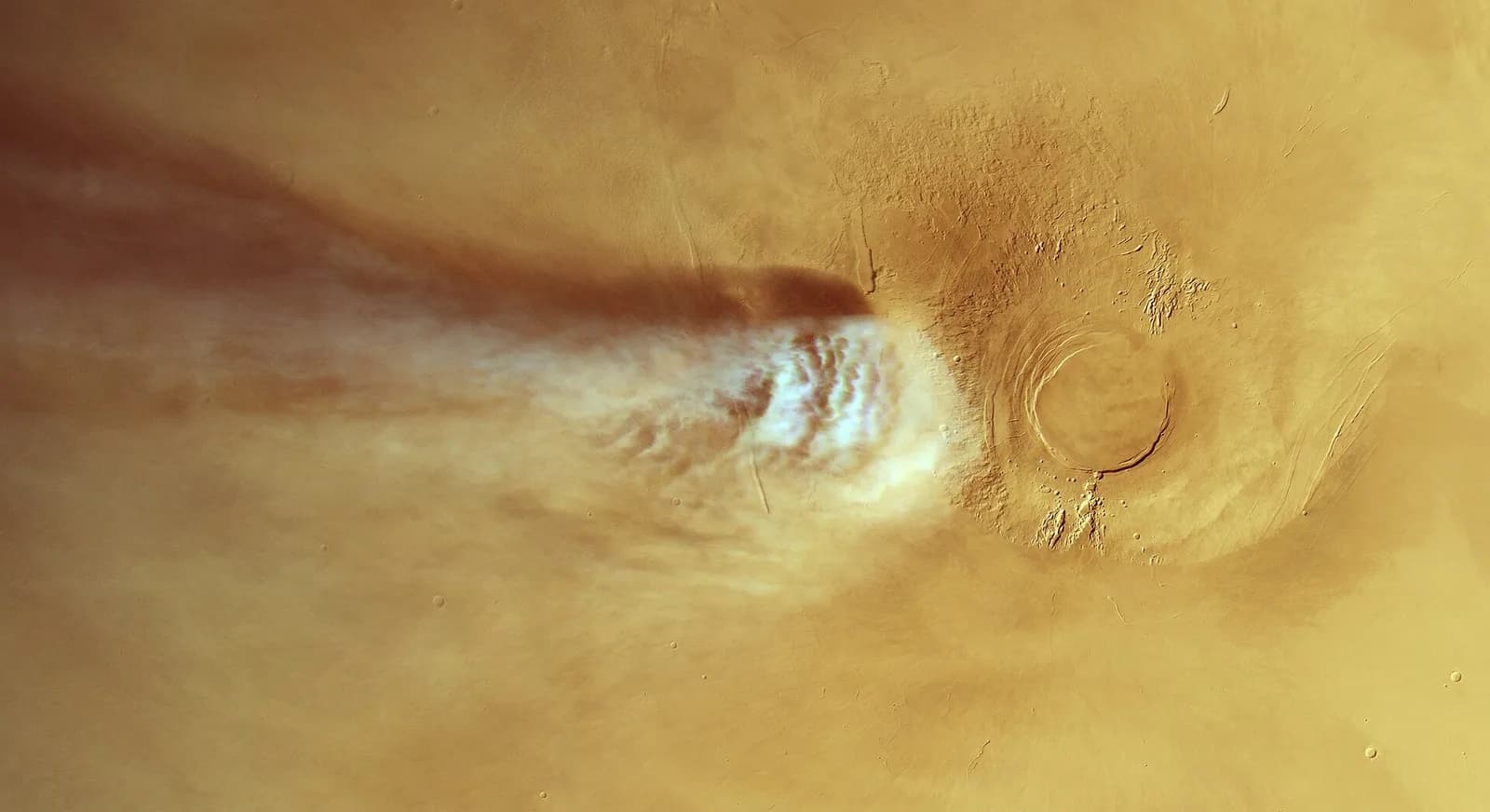
A new Mars Express study says the 1,800 km Arsia Mons cloud is made by ice appearing straight out of vapour, a process never seen in any planet's air.
OddBrief EditorialAI-assisted, human-reviewed
 Science
Key facts
- Who
- Jorge Hernández-Bernal (LMD/CNRS/Sorbonne Université) and colleagues, using ESA's Mars Express
- What
- the Arsia Mons Elongated Cloud appears to form by homogeneous nucleation, with no dust seeds
- Catch
- requires relative humidity over 100,000 times typical Earth levels, according to ESA
- Published
- Nature Geoscience, October 7, 2026
A cloud that streaks up to 1,800 km across Mars every morning seems to form in a way no one has seen in a planetary atmosphere: water vapour turning straight into ice with no dust grain to start on. The result, from a team using ESA's Mars Express orbiter, was published on October 7 in Nature Geoscience.
The catch is the price of that explanation. According to ESA, the process needs relative humidity more than 100,000 times higher than what people normally experience on Earth, a level nobody had shown Mars could reach.
A cloud that models could not make
The Arsia Mons Elongated Cloud appears downwind of the 20 km tall volcano in Mars's southern spring and summer. It grows, stretches and evaporates within a single morning, then does it again the next day, for months at a time.
Mars Express first revealed it in 2018, and scientists classed it as an orographic cloud, the kind that forms when wind is pushed up over a mountain. The problem was that weather simulations of Mars kept failing to produce anything that looked like it.
Ice with nothing to grow on
Clouds on Earth usually need seeds. Vapour condenses on specks of salt, soot, pollen or dust, a process called heterogeneous nucleation, and on Mars the seed is thought to be dust.
The new model only matched the images once the team let ice form without any seed at all, called homogeneous nucleation. Lead author Jorge Hernández-Bernal of LMD/CNRS/Sorbonne Université likened it to water droplets forming in mid-air inside a room instead of on a cold windowpane. Scientists had suggested it might happen high above Earth or Venus, yet it had never been spotted, ESA said.
The volcano supplies the extreme conditions. As wind crosses Arsia Mons, it sets off a strong wave that lifts moist air several kilometres in a few minutes, and the air cools by 30 degrees in about 10 minutes, according to ESA. Humidity spikes and the vapour freezes on the spot.
Why only Mars Express could see it
The study drew on all three of Mars Express's cameras: the Visual Monitoring Camera, the High Resolution Stereo Camera and OMEGA. The orbiter is one of the few spacecraft that can watch Mars in the morning, when the cloud exists, alongside ESA's ExoMars Trace Gas Orbiter.
The fit is not perfect. Hernández-Bernal said some parts of the modelled cloud still do not match the observations. What remains open is how often Mars's air reaches such humidity elsewhere, and whether the same seedless ice forms on other worlds, including exoplanets.
Sources
- Mars's oddest cloud may be even odder than we thoughtESAprimary source