Jupiter-bound Juice will skim Earth, then spend hours in its shadow
ESA plans a September 28 gravity assist just 8,640 kilometers from Earth, with batteries carrying Juice through a shadowed stretch.
OddBrief EditorialAI-assisted, human-reviewed
 Science
Key facts
- Spacecraft
- ESA Jupiter Icy Moons Explorer (Juice)
- Closest approach
- September 28, 2026, 11:45 UTC
- Altitude
- About 8,640 kilometers
- Science
- Ten instruments observing Earth and Moon
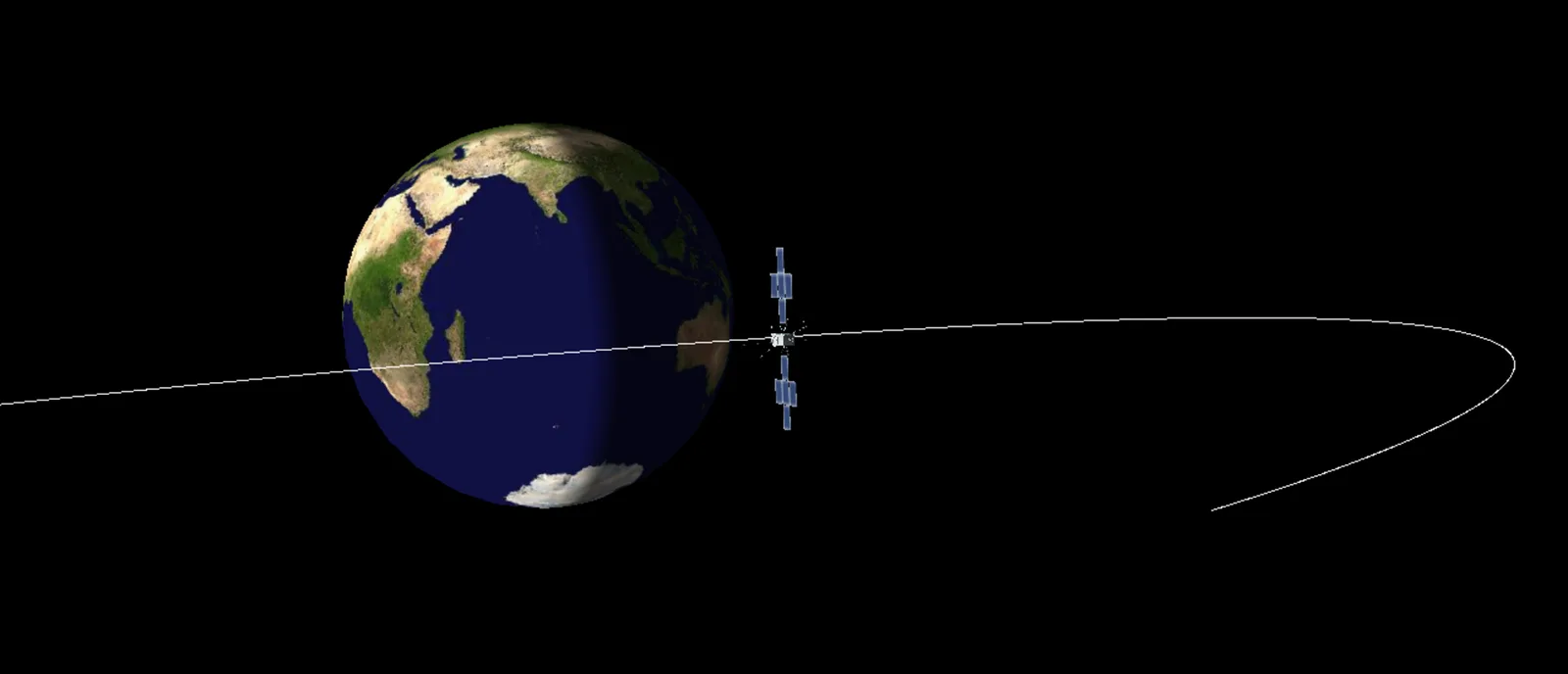
A spacecraft headed for Jupiter is returning to Earth to borrow momentum from the planet it left more than three years ago. The European Space Agency says Juice will pass within 8,640 kilometers of Earth on September 28, changing its direction and increasing its speed by about 3.5 kilometers per second. Its closest approach is expected over the Indian Ocean at 11:45 UTC.
The manoeuvre is part of a carefully staged route to the Jovian system, not a return to base. ESA announced the plan on September 21. The flyby is still ahead, so the predicted altitude, timing and trajectory change are plans to be confirmed by tracking and observations after the event.
Why an outer-planet mission comes home
Juice launched in April 2023 to study Jupiter and the ocean-bearing moons Ganymede, Callisto and Europa. Sending it directly to Jupiter with enough fuel to slow down and enter orbit would demand a much larger launch vehicle and propellant budget. Instead, mission controllers use planetary flybys to change the spacecraft's path and energy.
It has already made a lunar-Earth flyby in 2024 and a Venus flyby. This Earth encounter is designed to bend the trajectory about 20 degrees and set up another Earth pass in January 2029. ESA currently expects Jupiter arrival in July 2031 and an orbit around Ganymede in 2034.
The geometry is precise enough that controllers have reserved several opportunities for small course corrections. ESA says a manoeuvre four weeks before closest approach has already put Juice on track. On September 28, the team will be prepared for an emergency adjustment if a critical navigation error or collision risk emerges; it does not expect to need that burn.
A long stretch on batteries
The spacecraft will pass through Earth's shadow from 21:24 CEST on September 27 to 06:03 CEST on September 28, according to ESA. Solar power will be unavailable during that interval, leaving Juice on its batteries. The team is prioritizing instrument observations to avoid exhausting them. That operational constraint is one reason a seemingly familiar flyby remains a demanding event.
There is science to do while the spacecraft is near home. ESA plans to activate all 10 instruments for Earth and Moon observations between September 23 and October 3. Those measurements help teams calibrate equipment against known targets before it reaches Jupiter's moons. Juice is also expected to spend days in Earth's magnetotail, a region shaped by solar particles and our magnetic field.
Its navigation camera will look toward the Moon's horizon to test a technique for more accurate optical navigation. Two onboard monitoring cameras should capture pictures during the encounter, with ESA planning to share them afterward. The mission has not yet produced those images from the coming flyby.
What the pass will prove
A successful encounter would preserve fuel for the difficult work at Jupiter while giving instrument teams a rehearsal close to Earth. It would not by itself answer whether any Jovian moon is habitable. Juice's later survey of the moons and their environment is designed to explore that much larger question.
For observers on Earth, the spacecraft is expected to cross over Australia 15 to 30 minutes before closest approach. ESA says sufficiently equipped amateur astronomers may be able to track it. The near-term story is thus a rare meeting of orbital mechanics, mission operations and an opportunity to test instruments on a world scientists know well.
Sources
- Juice to fly past Earth for third gravity assistEuropean Space Agencyprimary source