ESA has three ways to measure a changing Earth, but will fly only one
Energy imbalance, upper-atmosphere oxygen and hidden ice conditions are competing for a single Earth Explorer mission.
OddBrief EditorialAI-assisted, human-reviewed
 Science
Key facts
- Decision
- ESA advanced ECO, Keystone and CryoRad on September 25
- Competition
- one concept will become Earth Explorer 12
- Target
- launch is expected around 2036
- Caveat
- no final mission has been selected
The European Space Agency advanced three proposed Earth-observing satellites on September 25, but only one is expected to become its twelfth Earth Explorer mission. The candidates would tackle unusually hard-to-measure questions about planetary heat, the upper atmosphere and polar ice, with a launch expected around 2036.
Three very different blind spots
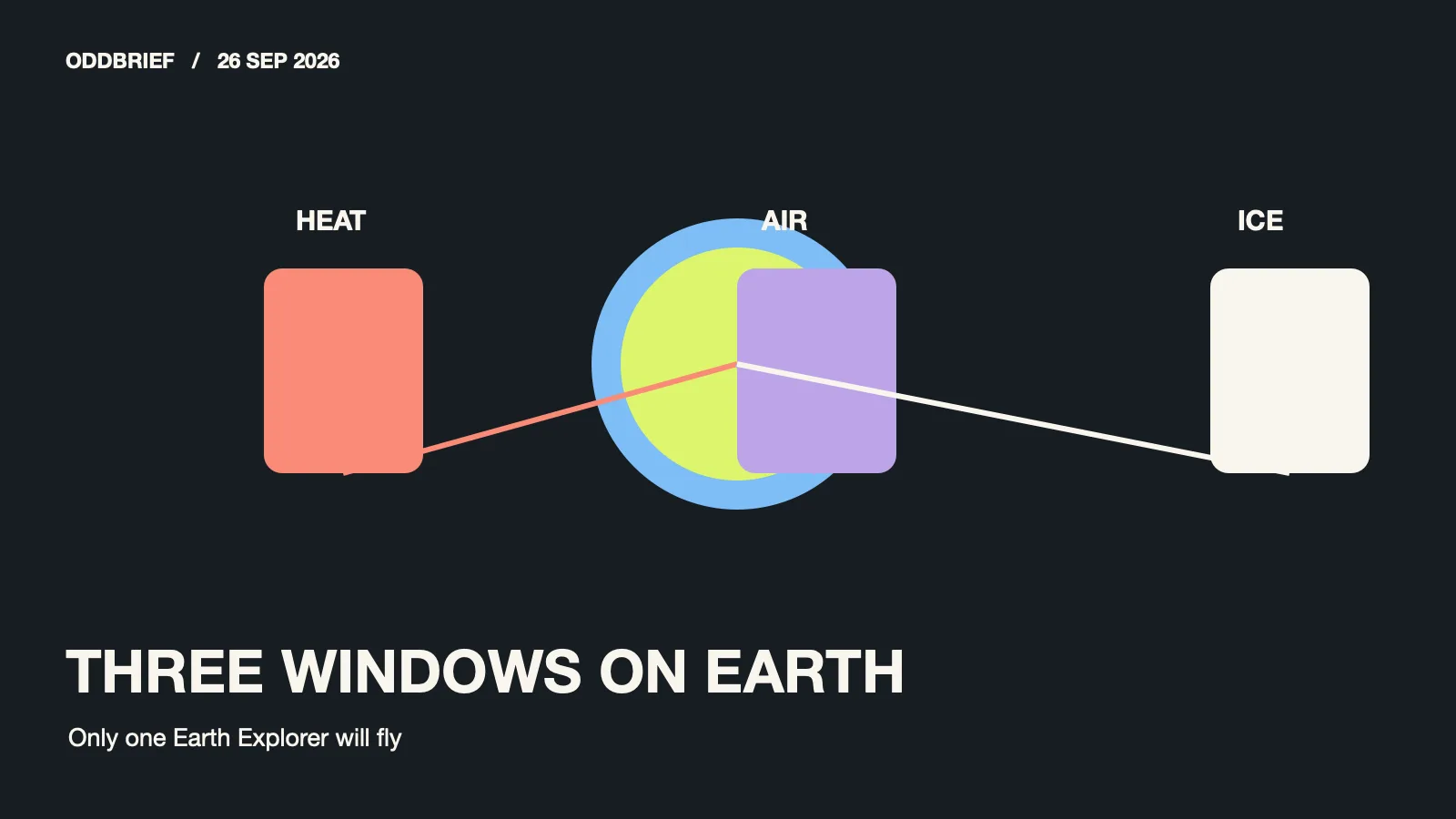
ECO would measure Earth's energy imbalance, the difference between the energy the planet receives and the energy it sends back to space. ESA's science advisers ranked the concept first on scientific merit because that imbalance is central to understanding ongoing climate change and whether mitigation is changing the trajectory.
The mission is also technically challenging, ESA acknowledged. Advancing ECO is a decision to investigate that difficulty further, not a claim that engineers have solved it or that the mission is guaranteed to fly.
Keystone would instead observe atomic oxygen alongside temperature, wind and other atmospheric constituents between roughly 50 and 250 kilometers above Earth. This poorly sampled region matters to the connections between the atmosphere below and space above. ESA says the same measurements could detect metals from space debris as it enters the atmosphere, an unexpectedly useful byproduct of looking at oxygen.
CryoRad would focus downward, directly measuring temperatures and conditions at the base of polar ice sheets. Those hidden conditions influence how ice moves and therefore how researchers assess future sea-level rise. It is a proposal to improve observations, not a new sea-level forecast.
A selection, then another selection
Four ideas were reviewed at a scientific consultation in July. ESA's advisory committee ranked ECO, Keystone, CryoRad and Hydroterra+ in that order. On September 25, ESA's Programme Board for Earth Observation moved the first three into the next preparatory phase, citing scientific relevance and program considerations.
One of the three is due to be chosen before ESA's next ministerial-level council meeting for implementation as Earth Explorer 12. That means this week's announcement reduced the field; it did not create three funded satellite missions. The agency has not given a final cost or firm launch date for any candidate.
The distinction matters because all three scientific questions are real, but a competitive mission line can answer only one of them at a time. A future decision will determine whether Europe's next bespoke Earth science satellite looks at the planet's energy budget, the nearly invisible middle atmosphere or the bottom of its ice sheets.
Sources
- Three Earth Explorer candidates go forwardESAprimary source