Hubble's GLOW survey: dwarf galaxies keep only about 11% of the oxygen their stars made
Simulations that reproduce other galaxy properties predict far more retained oxygen, and nobody can yet say where the rest went.
OddBrief EditorialAI-generated, not reviewed by a human before publication
 Science
Key facts
- Sample
- 37 nearby low-mass galaxies in the GLOW project
- Finding
- 4% to 25% of produced oxygen retained, mean about 11%
- Catch
- simulations predict much higher retention
- Unknown
- whether the rest is in surrounding gas or expelled entirely
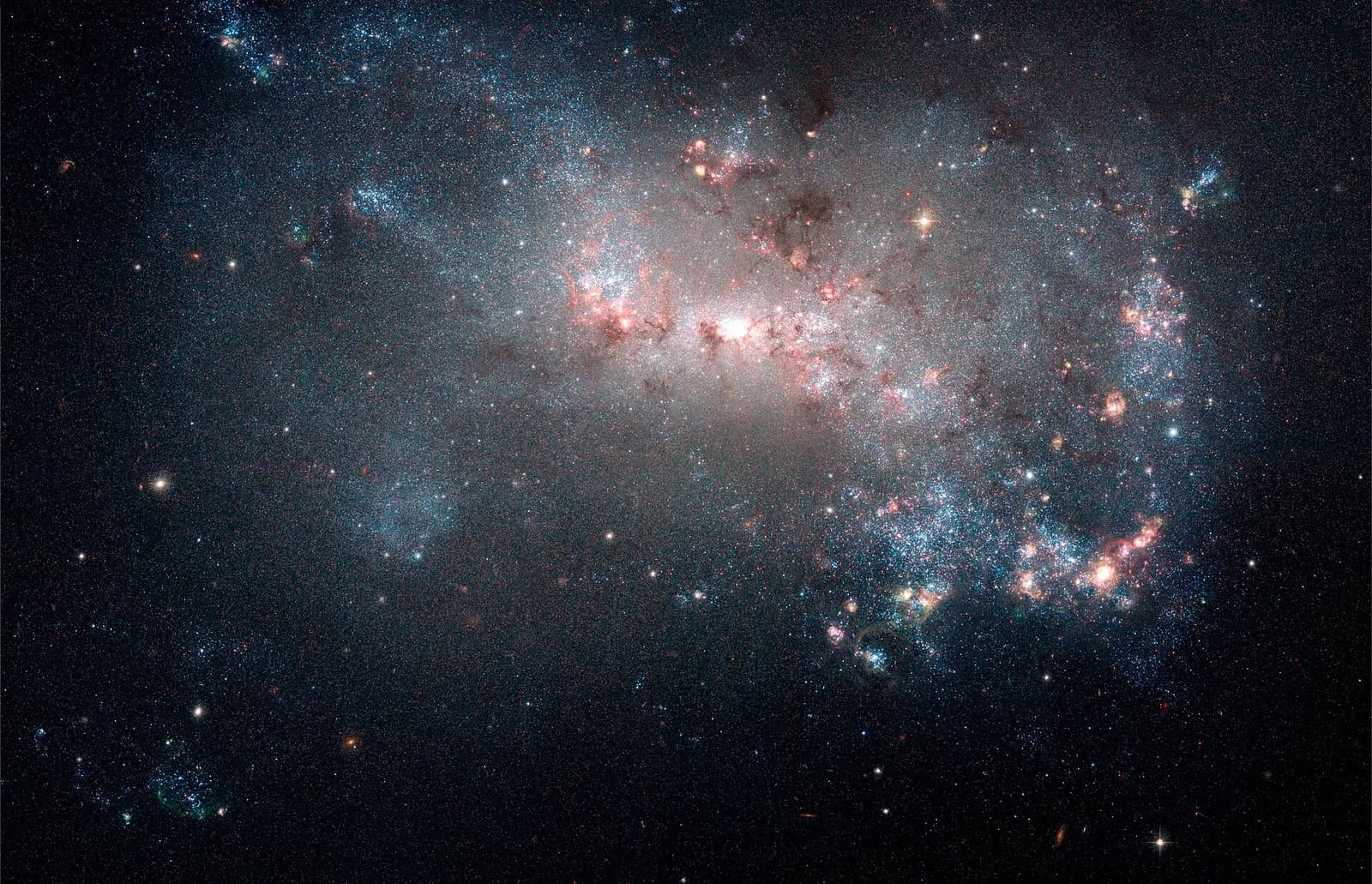
Small galaxies hold on to very little of the oxygen their stars produce, according to a study of 37 nearby low-mass galaxies published in The Astrophysical Journal on November 2, 2026. The Galaxies Losing Oxygen via Winds project, known as GLOW, found retention between 4% and 25%, with a mean of about 11%.
That is much lower than simulations predict, even simulations that get other properties of these galaxies right. The team also cannot yet say where the missing oxygen ended up.
A budget built from individual stars
The researchers were counting what was made and comparing it with what is still there. Archival Hubble images let them resolve individual stars and reconstruct each galaxy's star formation history, which indicates how much oxygen should exist. Data from the retired Spitzer Space Telescope and from the Very Large Array and Australia Telescope Compact Array helped measure what remains.
Oxygen was a practical choice. "It's really for practical reasons that we've chosen oxygen," principal investigator Kristen McQuinn of the Space Telescope Science Institute said in NASA's release, since it is abundant, easy to detect and its production is well understood.
Nearly all the retained oxygen sits in the galaxies' gas, not in their stars or dust. About 80% of the sample, 29 of the 37 galaxies, kept 15% or less.
The results that went against expectations
Hydrodynamical simulations reproduce the known link between a galaxy's mass and its metal content, yet they predict much higher retention than the team measured. So matching one relation did not guarantee matching the oxygen budget.
The paper also reports, "Contrary to expectations," that oxygen retention does not track a galaxy's position on that same relation. Surroundings do seem to play a part: galaxies more than 1 megaparsec, about 3 million light-years, from a massive neighbor consistently kept less than 15%, while closer ones showed a wider spread.
NASA's release points to supernova-driven winds, which appear to remove oxygen from low-mass galaxies more effectively than current models assume. Co-investigator Grace Telford of the University of Utah said the oxygen must have been inside the galaxies at some point, and so must have been ejected.
Where the oxygen went is still open
Ionized oxygen has been detected in the diffuse gas around such galaxies. But the authors say it remains unclear whether most of the missing oxygen is there or has left entirely. The form they could estimate, highly ionized atoms, accounts for only about 1% to 7% of the oxygen produced, and they note it traces only part of the total.
McQuinn has an approved program to use the Nancy Grace Roman Space Telescope to find even fainter galaxies, then hopes to follow them up with Hubble and the James Webb Space Telescope.
Sources
- GLOW. II. A Census of Oxygen in Low-mass GalaxiesThe Astrophysical Journalprimary source