Drosophila erecta males won't court without the smell of food, a Nature study finds
Rockefeller researchers found a fruit fly species whose males stay idle around females until a food scent appears, then court as a crowd.
OddBrief EditorialAI-assisted, human-reviewed
 Science
Key facts
- Who
- Vanessa Ruta's lab at Rockefeller University, first author Philipp Brand
- What
- D. erecta males court almost only when food odor is present
- Number
- over 90% of D. erecta matings happened on the vinegar patch
- Published
- Nature, November 4, 2026
Males of the fruit fly Drosophila erecta show almost no interest in mating unless they can smell food, according to a Rockefeller University study published in Nature on November 4, 2026. The scent switches on courtship in a brain circuit that close relatives also have, but only in this species does it act as a strict gate.
The work, led by first author Philipp Brand in Vanessa Ruta's lab, used apple cider vinegar as a stand-in for the smell of fermenting fruit.
Without the smell, nothing happens
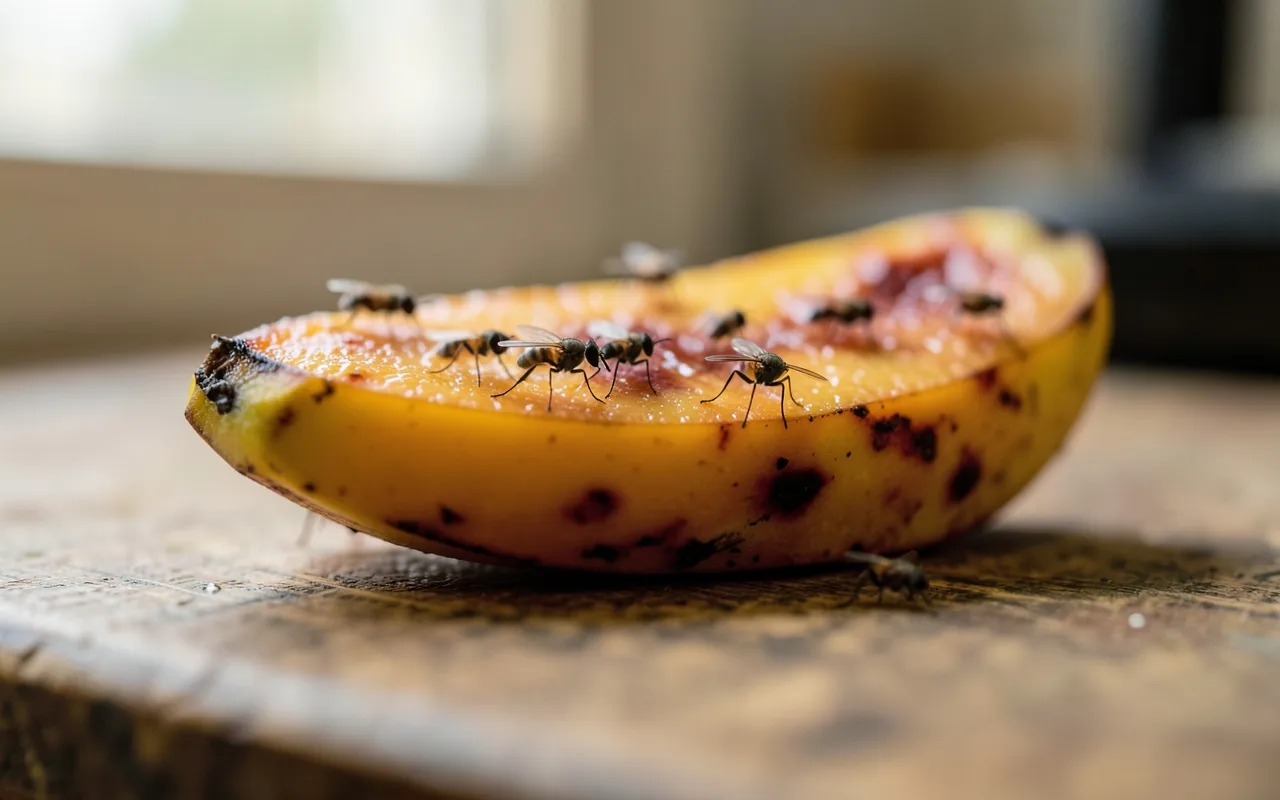
In chambers with no food odor, the D. erecta males mostly sat still, even when plenty of potential partners were nearby. Add a patch of vinegar on agar and the picture changed: males gathered on the patch and started approaching any fly close to them, whether it was a female or another male.
The location effect was striking. More than 90% of D. erecta matings took place on the vinegar patch, according to the university. "Without that scent, the males are completely uninterested in mating," Brand said in the release.
Drosophila melanogaster, the lab workhorse, and several of its close relatives behaved differently. They mated with or without the odor, and their matings were spread more widely around the chamber. The paper's abstract describes food odor in melanogaster as something that can raise arousal but is not needed for vigorous courtship.
A crowd turns the volume up
The team also found that D. erecta males courted harder in groups than when paired with a single female. Once the scent got males moving, the motion of the other flies filled each male's visual field, and that extra visual input pushed his arousal higher still. The authors describe this as a feedback loop that spreads courtship across the whole group.
To see what was happening in the brain, the researchers recorded neurons in males walking on an air-supported ball inside a virtual reality setup. Two sets of cells, P1 interneurons and LC10a visual neurons, became active in D. erecta only when food odor was present. The circuit itself is shared across the related species; what differs is how strongly smell controls it.
Brand framed the change as a reweighting of senses rather than a brand new arousal pathway: in D. erecta, smell decides whether visual cues can drive courtship at all.
Why one species waits for dinner
The ecology offers a likely reason. D. erecta breeds on the fruit of the West African screwpine, which is in season for only two to four months a year, according to the release. That leaves a short, crowded breeding window centered on the fruit itself. D. melanogaster, by contrast, can find food sources all year round.
Tying mating to the smell of the host fruit means males spend their effort where females and egg-laying sites actually are. Whether other host specialists in the genus use the same kind of scent gate was not tested in the study.
Sources
- This fruit fly's aphrodisiac reveals how social and environmental context shape mating practicesRockefeller University via EurekAlert!primary source