Arabidopsis plants with a 21-hour clock coped with salt better on 21-hour days
Washington University researchers found the clock protein TIC clumps into droplets under salt stress, and plants did best when their clock matched the day length.
OddBrief EditorialAI-assisted, human-reviewed
 Science
Key facts
- Who
- Xuehua Zhong and Wenwen Tian, Washington University in St. Louis
- What
- clock protein TIC forms droplets in the nucleus under salt and frees salt-protection genes
- Twist
- TIC-less plants run on about 21 hours and tolerated salt better on 21-hour days
- Published
- October 14, 2026, Science Advances
A plant's internal clock helps decide how well it survives salty soil, according to a study from Washington University in St. Louis published October 14 in Science Advances. Plants lacking a clock protein called TIC ran on a roughly 21-hour cycle and suffered more under salt, yet they handled salt better once they were grown on 21-hour days that matched their own rhythm.
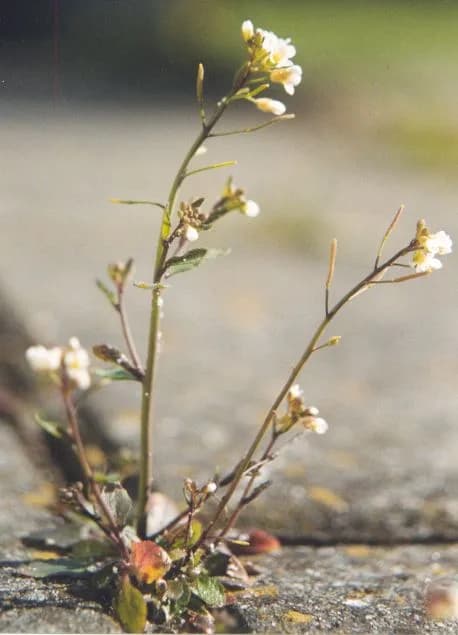
The work used Arabidopsis thaliana, the small weed that serves as the standard lab plant, and was led by biologist Xuehua Zhong and postdoctoral researcher Wenwen Tian.
A clock protein that reacts to salt
TIC is one of the proteins that keep a plant's daily rhythm. Exposed to salt, the team found, TIC rapidly clusters into small droplets in the nucleus of the cell.
The droplets draw in enzymes whose usual job is to hold back genes that defend against salt. Once that restraint weakens, the defensive genes become more active. Zhong described the result as the first evidence that a part of the clock responds directly to salt.
The 21-hour twist
The more surprising part came from the mutant plants. Without TIC, the plants were more sensitive to salt, and their internal clock ran about three hours short.
When the researchers changed the light schedule to 21-hour days so that the outside world matched the faulty clock, the same plants became more tolerant. "This shows that a plant copes with stress best when its internal clock is in sync with the outside world," Zhong said in the university's announcement.
That means the salt sensitivity was not only about missing a protein. Part of it came from a clock that was out of step with the day, which suggests the timing of a stress can change how the plant's genes respond.
Why farmers might care
Salt is a growing problem for agriculture. The researchers cite an estimate that about half of the world's irrigated farmland is affected by salinity to some degree, and hotter, drier weather plus the use of saline or recycled irrigation water make it worse.
In the researchers' view, breeders or gene editors might one day aim at TIC, or adjust the clocks of crops to fit the conditions where they grow. None of that has been tested in crops yet: the experiments were done in Arabidopsis under lab light schedules.
The announcement does not give the salt concentrations used, how much more sensitive the mutant plants were, or the names of the enzymes involved. Those details are in the paper.
Sources
- In plants, sense of time is connected with sense of dangerWashington University in St. Louis via EurekAlertprimary source
- Science Advances paperScience Advances