KAIST predicts blue OLED lifetime from a tiny brightness shift under a magnet
Instead of running blue OLEDs for hundreds of hours, KAIST measured how their light changes in a magnetic field, and the smallest responders lasted longest.
OddBrief EditorialAI-assisted, human-reviewed
 Tech
Key facts
- Who
- Seunghyup Yoo's group at KAIST, with partners at Kyung Hee and Hanbat National universities
- What
- a magnetic-field response measured early predicted which blue OLEDs kept brightness longest
- Tested on
- four blue phosphorescent OLED structures using the same emitter
- Published
- Nature Communications, online September 30, 2026; announced October 22
Researchers at KAIST say they can tell which blue OLEDs will last longest by placing them near an electromagnet and measuring how their light changes, rather than running them for days until they fade. The work, led by Professor Seunghyup Yoo and published in Nature Communications, found that devices with a smaller initial magnetic response kept their brightness longer.
The result has so far been shown on four types of blue phosphorescent OLED, all built from the same light-emitting material, and the team says wider validation is still needed.
Why blue is the slow part
Blue is the weak link in OLED displays because blue emitters tend to wear out faster than red and green ones. Checking how long a new design lasts usually means switching it on at a fixed current and watching its brightness drop for tens to hundreds of hours. Labs track points such as LT70 and LT50, when output falls to 70% or 50% of where it started.
That makes screening slow. Every new material or layer stack has to sit through the same long burn before engineers know whether it is worth pursuing.
A magnet as a shortcut
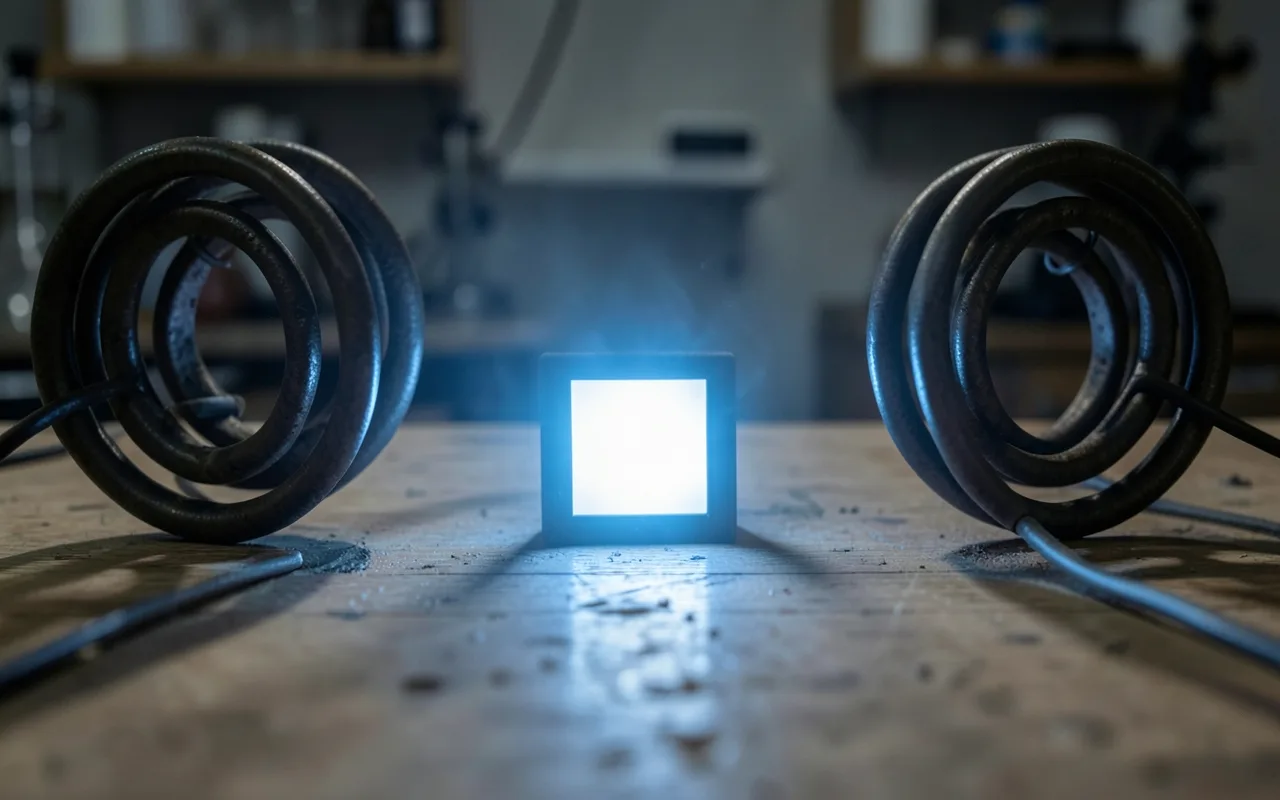
The KAIST team kept the OLEDs running at constant current and varied a magnetic field around them with an electromagnet. Under the field the devices became slightly brighter, by amounts far below what a human eye could notice, according to the release.
The researchers split that response into components and isolated the one most closely tied to degradation, turning it into a single score. Across the four device structures, the ones with the smallest initial magnetic response held their luminance longest in long-term operation.
Molecular simulations offered an explanation. Over long use, bonds inside the organic molecules can break and leave defects that interfere with light emission, and those defects appear to show up in how the device reacts to a magnetic field. The release does not give the field strength or the exact size of the brightness change.
The catch
The relationship is not universal yet. When the materials or the internal structure change, the factors that dominate the magnetic response can change too, so each type of device may need its own analysis. "However, further validation is needed before this relationship can be applied to a wider range of OLEDs," the release says.
Yoo described the method as a way to pick long-lived materials and structures quickly, and as a possible non-destructive evaluation technique, since the test does not require running a panel to failure. Dr. Jeoungmin Ji is first author, and partners included Kyung Hee University, Hanbat National University and the company ASTA Inc.
Whether display makers adopt it will depend on how well the correlation holds beyond these four devices.
Sources
- KAIST predicts the lifetime of blue OLEDs by measuring how their light responds to a magnetic fieldKAIST via EurekAlertprimary source