Virginia Tech finds soft circuits conduct through cracks filled with liquid metal
Engineers had pressed liquid metal composites into conductors for years without knowing why it worked. X-ray imaging shows the answer is fracture.
OddBrief EditorialAI-assisted, human-reviewed
 Tech
Key facts
- Who
- Michael Bartlett, Wuzhou Zu and Hugh P. Grennan, Virginia Tech mechanical engineering
- What
- pressure cracks the insulator between liquid metal droplets, and metal left in the cracks forms conductive paths
- How
- microscopy plus 3D X-ray imaging, tied to a fracture mechanics model of activation force
- Where
- published in Matter
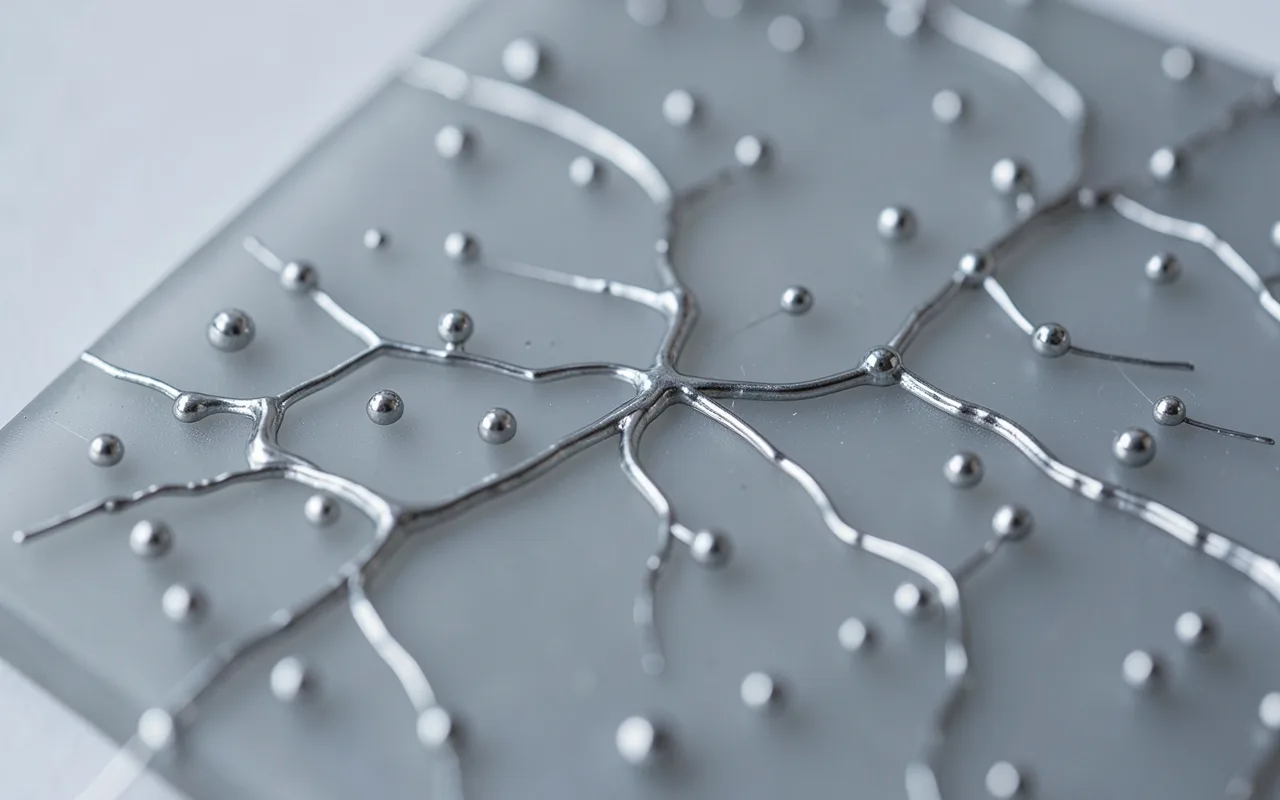
Virginia Tech engineers have shown why squeezing a rubbery material filled with liquid metal droplets turns it from an insulator into a conductor: the pressure cracks the insulating material between droplets, metal flows into the cracks and stays there, forming a wired network. The study appears in the journal Matter.
The odd part is that the trick itself was not new. Research groups, including this one, had been using pressure to activate these composites for years without a clear account of what happened inside.
A useful trick nobody could explain
Soft electronics for wearables and soft robots often rely on eutectic gallium indium, an alloy that is liquid at room temperature. Mixed into a polymer or rubber, it forms microscopic droplets. The surrounding material holds the droplets in place, but it also fills the spaces between them, so the composite starts out as an insulator.
"We did not really understand what was happening inside the material," said Michael Bartlett, associate professor of mechanical engineering, describing the years his group and others spent using pressure to switch these materials on.
That gap made it hard to control exactly where and when a soft device would become conductive, which matters when a sensor has to stretch, bend and survive damage without losing its wiring.
Watching the cracks form
Bartlett's team, with Ph.D. candidates Wuzhou Zu and Hugh P. Grennan, compressed samples and watched them under microscopes, then used 3D X-ray imaging to rebuild the internal pathways. The thin walls of insulator between neighboring droplets fractured under load, liquid metal moved into the gaps, and after the pressure was released the metal remained in the cracks as conductive bridges.
Zu said seeing the process in two dimensions and then reconstructing it in three showed how many small, local cracks add up to a network that carries current across the whole material.
The group then tied what it saw to a fracture mechanics model that estimates the load required to switch a given composite on. According to the university, the prediction held across designs ranging from millimeter-sized droplets down to droplets a few dozen micrometers wide.
Designing where the wires appear
If the activation force can be predicted, it can in principle be chosen. Grennan said the team can now design composites that switch on at the forces and length scales a particular application needs. Bartlett described the longer-term aim as soft electronics where conductivity is programmed in through the material's architecture and how it is processed.
The release does not give specific activation forces, conductivity values or any device built with the new model, and it does not say when manufacturers might use it. The next test is whether designers can use the model to place conductive paths precisely inside working stretchable sensors.
Sources
- Cracks that carry current: Researchers unlock the secrets of liquid metal and electricityVirginia Techprimary source