In-duct UV-C lamps dimmed in cold airflow, with a 60 W tube falling to 58% of peak
Singapore Institute of Technology tests show moving air cools UV-C tubes and cuts their output. The weaker 60 W lamp suffered far more than a 95 W one.
OddBrief EditorialAI-assisted, human-reviewed
 Tech
Key facts
- Who
- Singapore Institute of Technology, in the Journal of Building Design and Environment
- Test
- 95 W and 60 W UV-C lamps in a 2.7 m duct, air between 1.1 and 2.5 m/s and 14 and 22 °C
- Result
- the 60 W lamp ran at about 58% to 74% of peak output in cooler air
- Caveat
- microbe reductions are calculated, no live organisms were tested
Cold air rushing through a ventilation duct can quietly dim the UV-C lamps installed there to disinfect it, according to a study from the Singapore Institute of Technology. In the team's tests, a 60 W lamp delivered as little as 58% of its peak measured output in cooler, faster air, while a 95 W lamp barely changed.
The usual worry with in-duct UV-C is time: the faster the air moves, the less time each particle spends under the lamp. The study, published in the Journal of Building Design and Environment and announced on October 24, adds a second effect. Moving air also cools the lamp tube itself, and a cooler low-pressure mercury lamp emits less germicidal light.
Same duct, two very different lamps
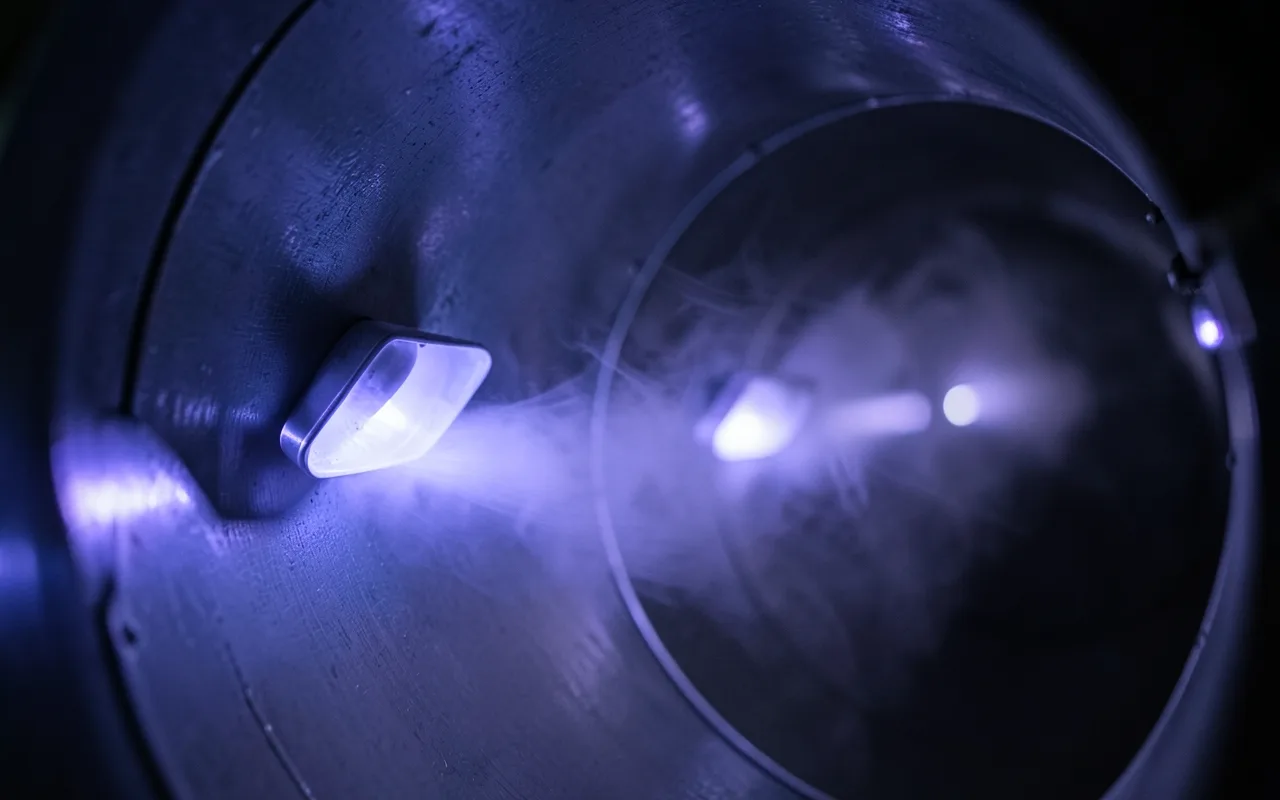
The researchers placed lamps rated 95 W and 60 W in a square duct about 2.7 meters long. Air speed ranged between 1.1 and 2.5 meters per second and inlet air between 14 and 22 °C, then measured lamp surface temperature and irradiance at 254 nanometers, the wavelength that does the disinfecting.
The 95 W lamp averaged roughly 273 to 316 W/m² across the conditions and stayed at about 97% to 100% of its maximum at the two lower airflow settings. The 60 W lamp swung from about 151 to 262 W/m². At the cooler inlet temperatures it ran at roughly 58% to 74% of its best measured output, depending on airflow, recovering to about 86% to 100% only when the incoming air reached 22 °C.
As airflow rose, convection took over the lamp's heat loss. The ratio of convective to radiative heat loss climbed from about 4.6 to 5.0 at low flow to about 7.1 to 7.6 at 2.5 m/s. The practical upshot, as the authors frame it, is that a lamp's power rating alone can misjudge how well it disinfects in a real duct.
Viruses fare worse than mold spores
Using the measured light fields, the team calculated the UV dose particles would receive. With six lamps and air at the slowest 1.1 m/s setting, the 95 W array gave an average modeled dose near 191 J/m², against roughly 146 J/m² from six 60 W tubes. Where the lamps sat in the array changed where the high and low dose zones fell.
Plugging in published susceptibility values, the authors estimated reductions above 6 log, a millionfold, for several susceptible viruses and bacteria in some configurations. Mold spores were another story. Predicted reductions for Aspergillus niger stayed below about 0.05 log, and generally below about 0.4 log for two other Aspergillus species.
For this particular system, the best balance of light intensity and time under the lamp came at about 1.1 to 1.5 m/s.
What the numbers do not show
No live microbes went through the duct. The reductions are calculations built on a simplified model that assumes plug flow and fixed particle paths, and it ignores turbulent mixing, deposition and clumping. Lamp ageing, dirt on the tubes and ballast behavior can all shift real performance.
The authors also say the 1.1 to 1.5 m/s window applies to their setup and is not a general design rule. They call for controlled bioaerosol experiments to test the predictions, which have not yet been done.
Sources
- Airflow can cool UV-C lamps and alter in-duct disinfection estimatesEurekAlert! / Science Exploration Pressprimary source
- Thermal-optical coupling and germicidal assessment of in-duct UV-C systemsJournal of Building Design and Environment