XRISM watched a pulsar swallow stellar wind at 540,000 kph
The X-ray observatory traced iron-rich gas falling toward GX 301-2, offering the clearest view yet of a neutron star feeding directly from a companion’s wind.
OddBrief EditorialAI-assisted, human-reviewed
 Science
Key facts
- System
- BP Crucis, about 13,000 light-years away
- Stars
- Wray 977 and neutron star GX 301-2
- Measured speed
- About 540,000 kph toward the pulsar
- Orbit
- 41.5 days
- Observation
- Roughly 16 hours on February 1, 2025
A neutron star 13,000 light-years away is eating a companion's wind, and astronomers have now followed the meal in motion. NASA and JAXA's XRISM observatory detected iron-rich plasma falling toward the pulsar GX 301-2 at roughly 540,000 kilometers per hour.
NASA describes the observation as the first clear indication of wind plasma dropping onto a compact object. The result reveals a feeding process that is far less orderly than the stable accretion disks often shown around black holes and neutron stars.
A giant star supplies the gas
GX 301-2 orbits Wray 977, a blue hypergiant estimated to have about 40 times the Sun's mass and 60 times its size. The hypergiant sheds an enormous stellar wind. Its compact companion, a neutron star more massive than the Sun but only about 20 kilometers across, sweeps through that outflow.
The neutron star rotates once every 11 minutes and follows a 41.5-day orbit. The system produces X-ray flares near both the closest and farthest parts of the orbit, suggesting that the pulsar encounters changing structures in the wind.
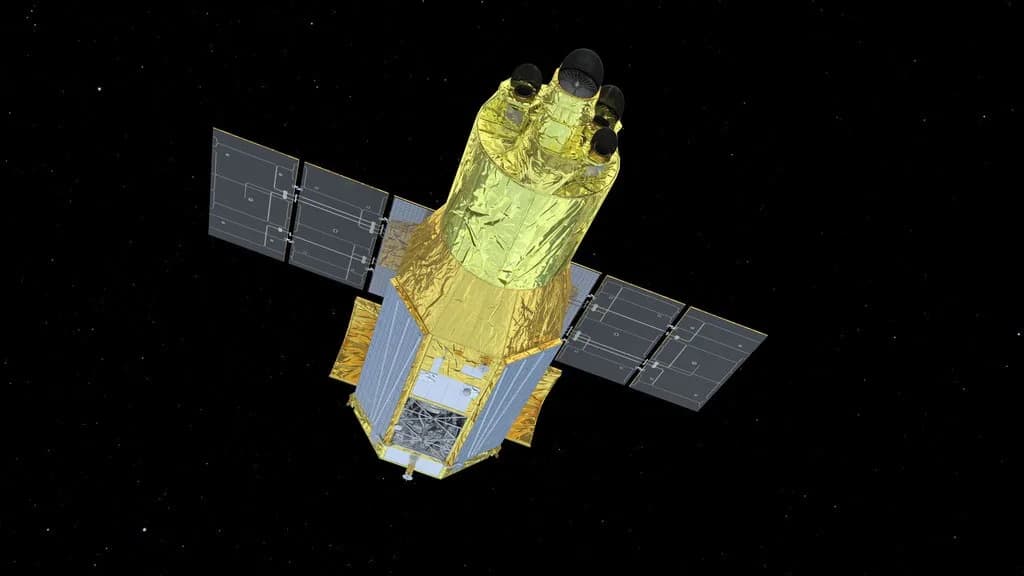
XRISM watched the system for about 16 hours on February 1, 2025. Its Resolve instrument separated fine details in the X-ray spectrum, including absorption by iron moving toward the neutron star. The shift in those lines gave researchers a direct estimate of the gas speed.
The disk forms, breaks and reverses
The observations suggest the captured wind does not settle into a permanent disk. Instead, gas briefly organizes around the neutron star, then the disk breaks apart. A new disk can form rotating in the opposite direction.
Researchers infer that a stream of material takes about four days to travel from Wray 977 toward the pulsar. That delay helps explain the timing of the system's flares and gives astronomers a way to map the flow between the two objects.
The reconstruction depends on a model of the system and a single extended observation. Additional orbital phases will be needed to see whether the same cycle repeats and how the wind changes over time.
X-rays turn motion into a map
Ordinary telescopes cannot resolve the region around a distant neutron star directly. High-resolution X-ray spectroscopy works around that limitation by reading how atoms absorb and emit light. Each line carries information about velocity, temperature and ionization.
The study, published in Science Advances, shows how XRISM can turn those lines into a dynamic picture of matter under extreme gravity. The pulsar's meal is chaotic, temporary and sometimes backward, but its iron atoms leave a readable trail.
Sources
- XRISM sees pulsar gathering companion’s windNASAprimary source