Thirteen trapped ions simulated a string that makes new particles
A quantum device reproduced a model of string breaking, a process associated with high-energy physics. It did not create matter from nothing or recreate the Big Bang.
OddBrief EditorialAI-assisted, human-reviewed
 Science
Key facts
- Fact 1
- Researchers encoded a string-breaking model in 13 trapped ions
- Fact 2
- The paper was published September 23 in Nature Physics
- Fact 3
- A classical simulation checked this small experiment
- Fact 4
- Related simulations exist on superconducting and neutral-atom platforms
Physicists used a chain of 13 trapped ions to model what happens when the link between fundamental particles is stretched until new particle pairs appear. A September 25 account from the University of Maryland's Joint Center for Quantum Information and Computer Science describes the experiment as a test of whether controllable quantum hardware can study dynamics usually associated with particle colliders.
A tiny laboratory for a vast question
Quarks are bound inside particles such as protons and neutrons. Pulling a quark pair apart does not simply leave two isolated quarks. Energy grows in the connection between them until, in the right conditions, it can produce another pair. Physicists call this string breaking. Studying the process in full detail is difficult because the relevant quantum systems become complicated quickly.
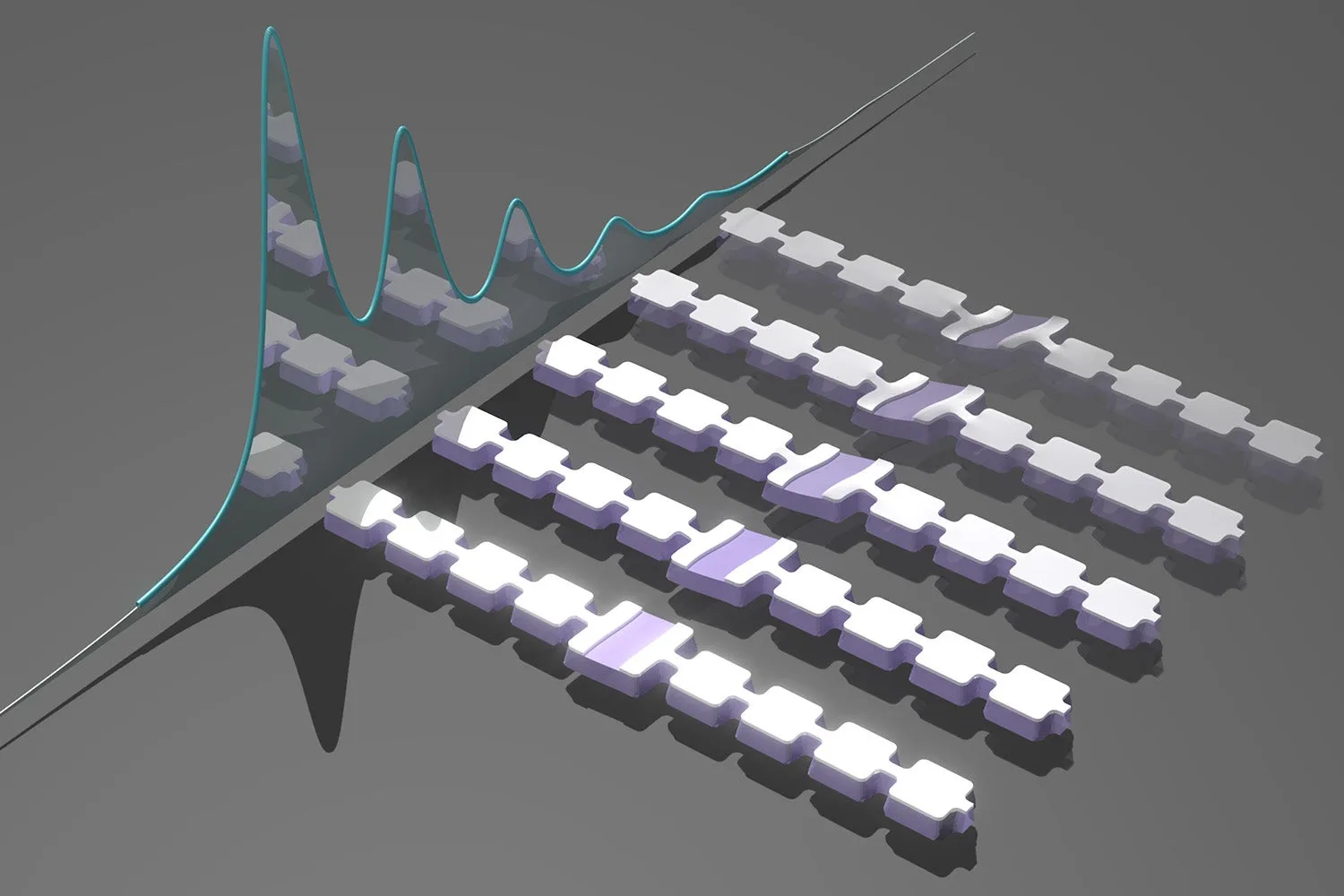
The researchers did not place actual quarks in an ion trap. They encoded a mathematical model of string breaking into the 13-ion chain. Lasers adjusted interactions among the ions, while measurements tracked the system as it moved out of equilibrium. The team reports observing the emergence of effective charges and reconstructing dynamics analogous to a breaking string.
The group also simulated the same setup on a classical computer and found agreement with the experiment. That is an important limit on the claim: at this scale, ordinary computation could still check the answer. The hoped-for advantage comes with larger, harder models that may eventually outrun classical methods.
A benchmark, not a miniature universe
The underlying paper appeared in Nature Physics on September 23. The Maryland release notes that two other teams have simulated related string-breaking behavior on superconducting and neutral-atom platforms. The trapped-ion result therefore adds a comparison among leading quantum-hardware approaches, rather than a lone demonstration of a wholly new phenomenon.
Researchers link the broader physics to conditions in particle colliders and the early universe. That does not mean the device replayed the Big Bang, established how all matter formed or found a new fundamental particle. It modeled a specific process whose behavior can be compared with theory.
The distinction is what makes the result interesting. A controlled chain of atoms can become an experimental stand-in for equations that are hard to solve directly. If the method scales while preserving accuracy, it could give physicists another way to explore high-energy phenomena. This experiment shows the approach can work on a small model; its usefulness for unsolved questions remains ahead.
Sources
- Quantum device simulates matter popping into existenceUniversity of Maryland JQIprimary source