Stanford watches a quantum jump of sound happen in real time
Stanford physicists report the first direct real-time observation of individual phonon jumps in a mechanical resonator, published in Science in 2026. Led by Amir Safavi-Naeini, with co-first authors Takuma Makihara and Erik Szakiel, the team caught sound quanta flipping from energy state 1 to 0 during roughly two milliseconds of vibration.
OddBrief EditorialAI-assisted, human-reviewed
 Science
Key facts
- Discovery
- A Stanford-led team directly observed individual phonon jumps in a mechanical resonator in real time.
- Method
- A superconducting qubit repeatedly checked whether the resonator occupied energy state 1 or 0 during roughly two milliseconds of vibration.
- Context
- Sound was the last major quantum-jump domain after trapped ions in 1986 and photons in 2007.
- Result
- The data show a sudden staircase-like transition rather than a smooth decay, confirming discrete energy changes in mechanical motion.
- Limits
- The result concerns a carefully engineered mechanical mode, not household speakers or general-purpose quantum computers.
- Significance
- The detector can watch energy leave a mechanical system one quantum at a time without destroying the jump.
Sound usually feels continuous. A struck bell fades. A speaker cone settles. At the smallest scale that physicists care about, vibration is not a smooth fade at all. It drops in discrete packets. A Stanford-led team has now watched those packets, called phonons, jump in real time, closing a missing chapter in the long story of quantum jumps.
From ions and light to mechanical motion
Quantum jumps, sudden transitions between energy states, have been part of physics since the early twentieth century. Experimenters first caught them in trapped ions in 1986 and later in photons, the quanta of light, in 2007. Sound was the awkward holdout. A phonon is not a lonely particle the way a photon can be. It is the coordinated motion of a large group of atoms, which makes catching a single jump harder even when theory says the energy must still change in steps.
Earlier work had found evidence that mechanical systems obey those steps. What remained elusive was a direct, real-time recording of an individual phonon flipping between states. In a Science paper titled Quantum jumps of sound, Takuma Makihara and colleagues report exactly that observation in a mechanical resonator. Stanford physicist Amir Safavi-Naeini led the effort. Co-first authors Takuma Makihara and Erik Szakiel paired the microscopic resonator with a superconducting qubit that could act as a repeated detector.
Catching a jump inside a two-millisecond ring
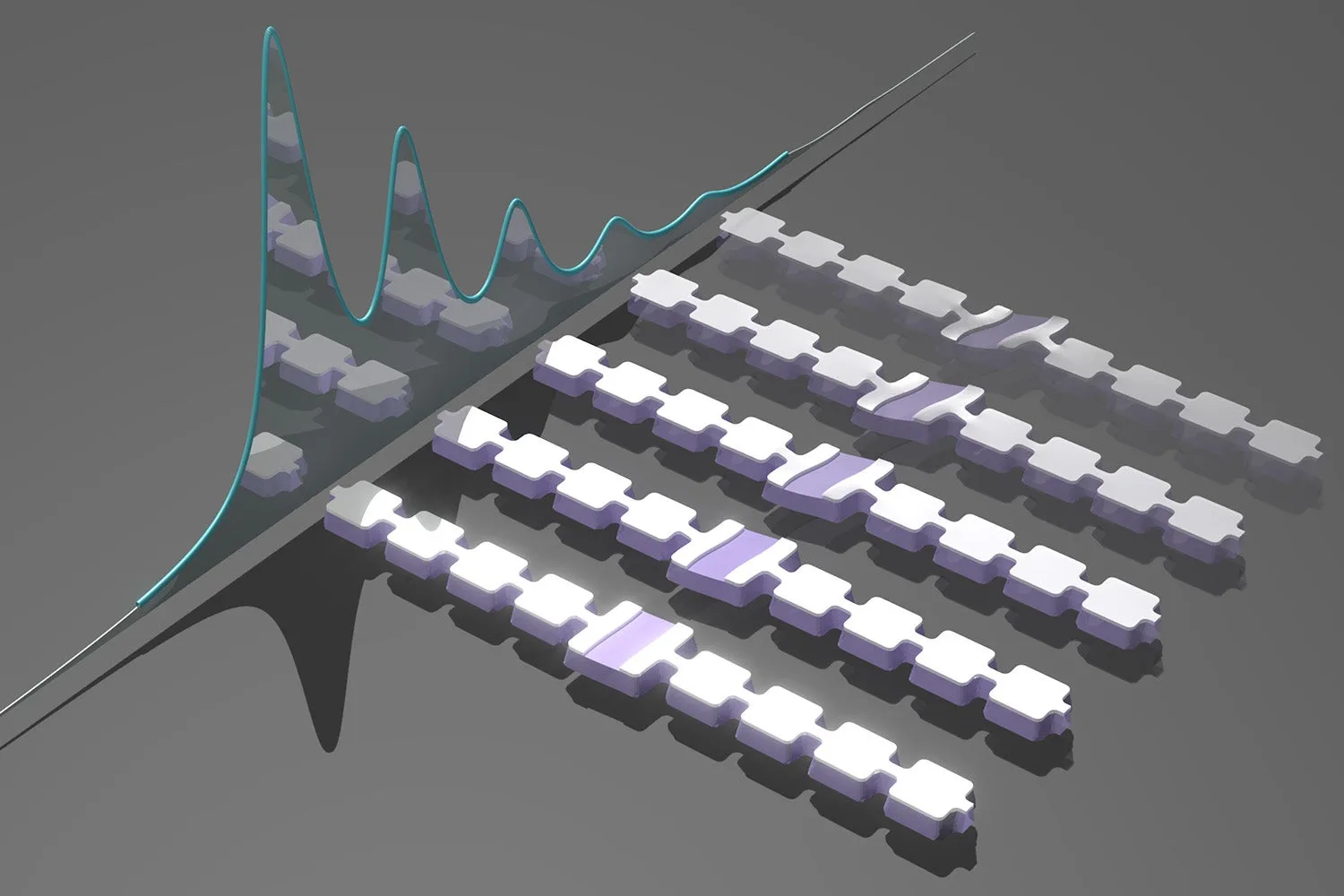
The experimental trick was patience at quantum speed. According to coverage of the study, the resonator rings for roughly two milliseconds. During that window the qubit can check, again and again, whether the phonon sits in energy state 1 or energy state 0. Hundreds of those readings let the team pinpoint the moment the system jumps down. To human senses the vibration would look like a gentle decay. In the data it looks like a staircase with a sudden step.
That distinction matters because mechanical resonators sit at the border between the quantum world and devices people actually build. Sound and vibration couple naturally to sensors, clocks, and future quantum networks. Seeing individual phonon jumps in real time is not only a historical completion of the quantum-jump trilogy across matter, light, and sound. It is also a way to watch energy leave a mechanical system one quantum at a time, with a detector that can keep asking the same question while the resonator is still ringing.
What the result does and does not claim
The Stanford result should be read carefully. It does not mean household speakers suddenly became quantum computers. It means a carefully engineered mechanical mode, read out through a superconducting circuit, finally revealed the same abrupt energy bookkeeping that ions and photons already showed. The paper’s supporting data and code have also been posted publicly, which is a useful signal that the team wants other groups to inspect the trajectories rather than take the highlight reel on faith.
The odd angle is almost poetic. Physics spent a century proving that nature sometimes refuses to change smoothly. Light jumped. Ions jumped. Now sound has been caught mid-leap, not as a metaphor but as a measured transition from one to zero while the resonator was still singing for a couple of milliseconds. The quiet part of the story is the engineering: a detector fast and gentle enough to ask hundreds of times without destroying the very jump it was trying to see.
Sources
- Researchers observe first real-time quantum jump in soundStanford Reportprimary source
- Quantum jumps of soundScience