A stroke changed the neighborhood around brain tumors in lab models
Baylor researchers found injury-linked cell changes that promoted glioma in models; the finding is not a clinical risk test.
OddBrief EditorialAI-assisted, human-reviewed
 Science
Key facts
- Study
- Baylor and collaborators reported findings September 25
- Models
- human and mouse glioma systems
- Mechanism
- altered astrocytes, microglia and macrophages
- Caveat
- no preventive therapy shown in patients
Baylor College of Medicine researchers reported September 25 that a stroke promoted glioma growth and spread into injured areas in human and mouse models. The study offers a possible biological link between brain injury and tumor behavior, but it does not show that a stroke will cause cancer in any particular patient.
A changed environment, not just changed tumor cells
Earlier clinical and epidemiological studies have suggested an association between brain injury and later brain tumors. Baylor's team investigated how a stroke might affect a glioma already present in experimental systems, focusing on the tissue around the tumor as well as the malignant cells.
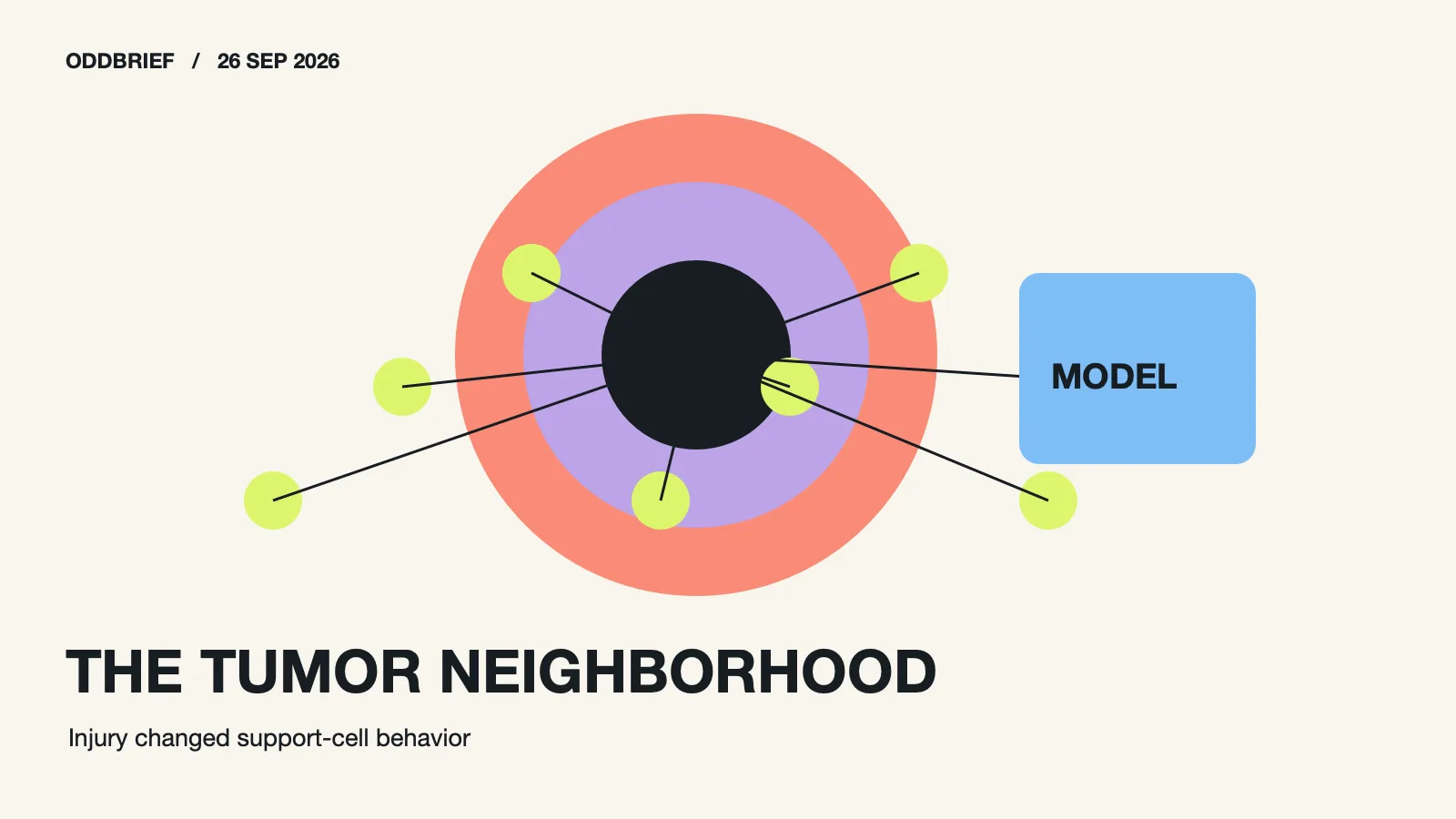
The researchers reported that stroke was followed by greater tumor infiltration into injured brain regions and shorter survival in the models they examined. They then found a remodeled tumor environment, including a distinct population of tumor-associated astrocytes, altered microglia and accumulated macrophages. Astrocytes are support cells in the brain; microglia and macrophages participate in immune responses.
One striking observation was reduced calcium activity in the tumor-associated astrocytes. When the investigators restored astrocyte calcium signaling or removed tumor-associated macrophages in their models, stroke-induced glioma progression was suppressed. That makes these cells candidate mechanisms to study, rather than proof of a treatment ready for people.
What the experiment does and does not say
Baylor cited prior estimates suggesting brain-tumor risk after stroke or traumatic injury may be several times higher in some patient groups, with variation by age and sex. Those observational figures are not a personal prognosis. The new experiments concentrated on stroke and glioma, so they cannot automatically be generalized to every kind of brain injury or brain tumor.
The result also distinguishes two claims often blurred together. One concerns whether injury can create a cellular environment that helps an existing tumor grow. Another concerns whether injury initiates a new tumor. The reported models speak most directly to the former and identify plausible pathways for further work on the latter.
Researchers may now test whether the astrocyte and immune-cell changes appear consistently in patient samples, whether they precede or follow tumor growth and whether interfering with them is safe. None of those steps is complete. The study's immediate contribution is a more specific question about the tumor's neighborhood after a stroke, not a new clinical screening rule.
Sources
- Researchers link brain injury to brain tumorsBaylor College of Medicineprimary source