One-minute total-body PET scans outscored standard scans in a 24-patient Peter Mac study
Readers rated one-minute images from a 128 cm GE scanner above routine PET/CT, but the study scored image quality, not whether lesions were found.
OddBrief EditorialAI-assisted, human-reviewed
 Science
Key facts
- Who
- Peter MacCallum Cancer Centre, presented at EANM'26 in Vienna on October 18
- Scanner
- GE HealthCare Omni 128 cm long axial field-of-view PET/CT
- Result
- one-minute images scored 4.5 for diagnostic quality, conventional scans 3.9
- Catch
- 24 patients, and quality was rated by readers, not checked for missed lesions
A whole-body PET scan lasting one minute on a long scanner produced images that blinded specialists rated higher than the standard scans patients already get, according to a study from Peter MacCallum Cancer Centre in Melbourne presented on October 18 at the European Association of Nuclear Medicine congress in Vienna. The catch is that the study measured how good the pictures looked, not whether doctors found every tumour.
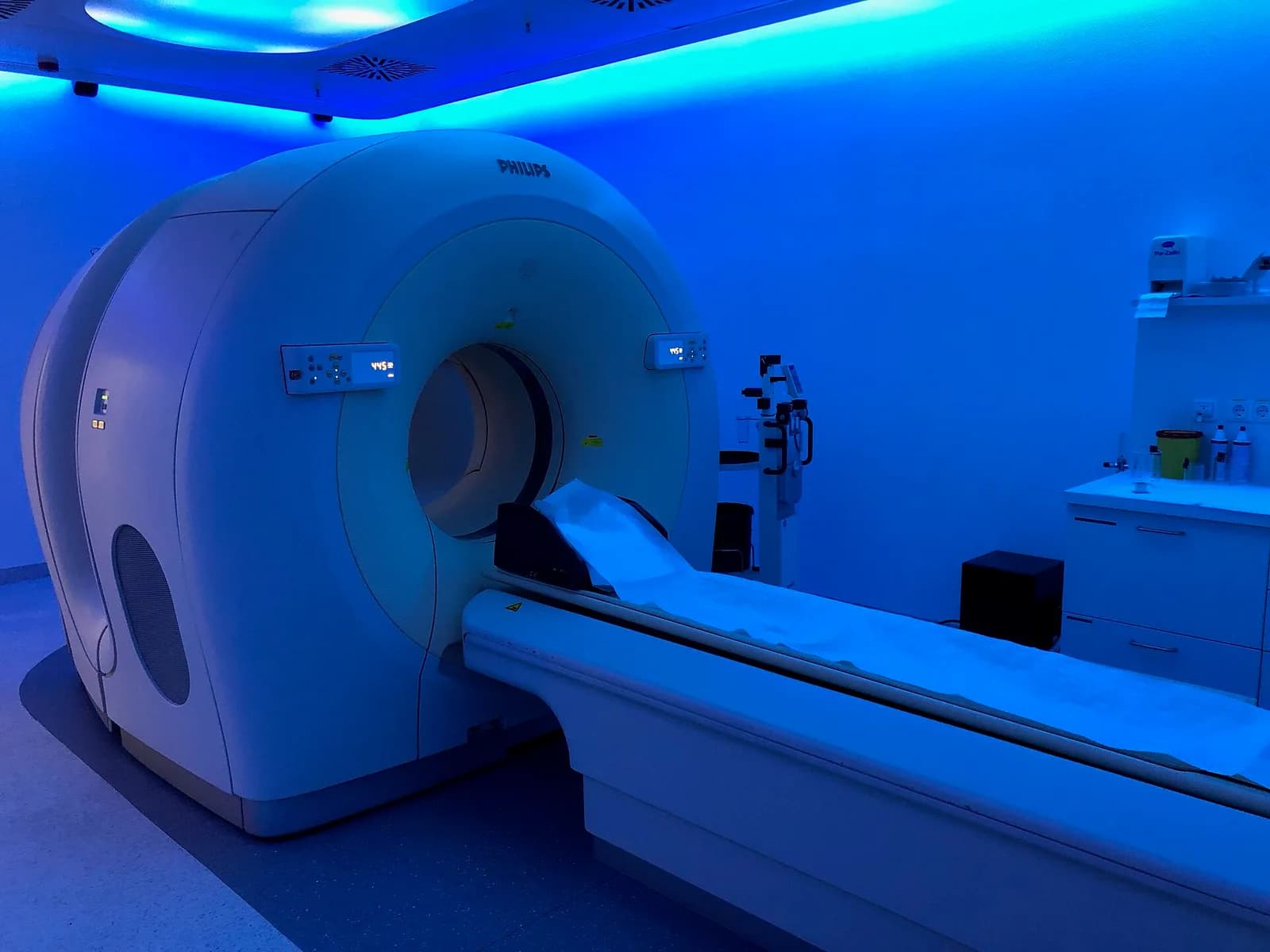
The work, called EQUIP, tested GE HealthCare's Omni 128 cm system, a long axial field-of-view PET/CT scanner that covers most of the body at once instead of stepping through five or six bed positions.
How the comparison worked
The trial enrolled 24 people who were already having a routine scan with one of five different radiotracers. Each person had their normal scan on a conventional short scanner, then a 10-minute scan on the long machine.
From that 10-minute recording the team also built shorter versions that used just 5, 3, 2 or 1 minute of it. A pair of specialists, blind to which version they were looking at, rated every image from 1 to 5 for overall quality, sharpness, how clearly lesions stood out, and noise.
Overall diagnostic quality averaged 5.0 for the 10- and 5-minute images, 4.9 at 3 and 2 minutes, and 4.5 at one minute. The conventional scans averaged 3.9 and came in lower than the long scanner in every category at every scan length.
Where the one-minute scans fell short
Quality did drop as the scans got shorter, and the steepest fall came at one minute, mostly in image noise. Nothing at two minutes or longer dropped below 4 on any measure, and no one-minute image dropped below 3. Even so, the one-minute images sat closer to the 10-minute versions than to the conventional scans.
Lead author Cameron Pain, a nuclear medicine physicist at Peter Mac, said that "even when we cut the acquisition time by 90%, image quality exceeded current standard-of-care methods." The congress release describes the extra sensitivity as a trade-off: hospitals could use it for faster scans and more patients a day, or keep scan times and give patients less radioactive tracer.
What the study cannot say yet
Reader scores are not the same as diagnostic accuracy. The congress release itself calls for bigger trials to check that such brief scans still catch small, faint tumours, and notes that the effect on hospital workflow and on patients in routine care has not been measured.
The sample was also small, at 24 people spread across five tracers, and only one scanner model was tested. The study is registered as NCT07263815, and the results were presented as a congress talk.
Sources
- Next-generation total-body PET scanner can produce diagnostic-quality images in as little as one minuteEuropean Association of Nuclear Medicineprimary source