ESA's Euclid found its first new comet, C/2026 S1, in images meant for distant galaxies
A Helsinki PhD student's software spotted a streak in 16 Euclid exposures. The comet sits far above the planets' plane, about 1.3 billion km away.
OddBrief EditorialAI-assisted, human-reviewed
 Science
Key facts
- Who
- ESA's Euclid space telescope and University of Helsinki PhD student Mikko Pöntinen
- What
- first previously unknown comet found by Euclid, C/2026 S1 (Euclid)
- When
- imaged September 16 to 24, confirmed by the Minor Planet Center on October 8, 2026
- Where
- about 1.3 billion km from Earth, far above the plane of the planets
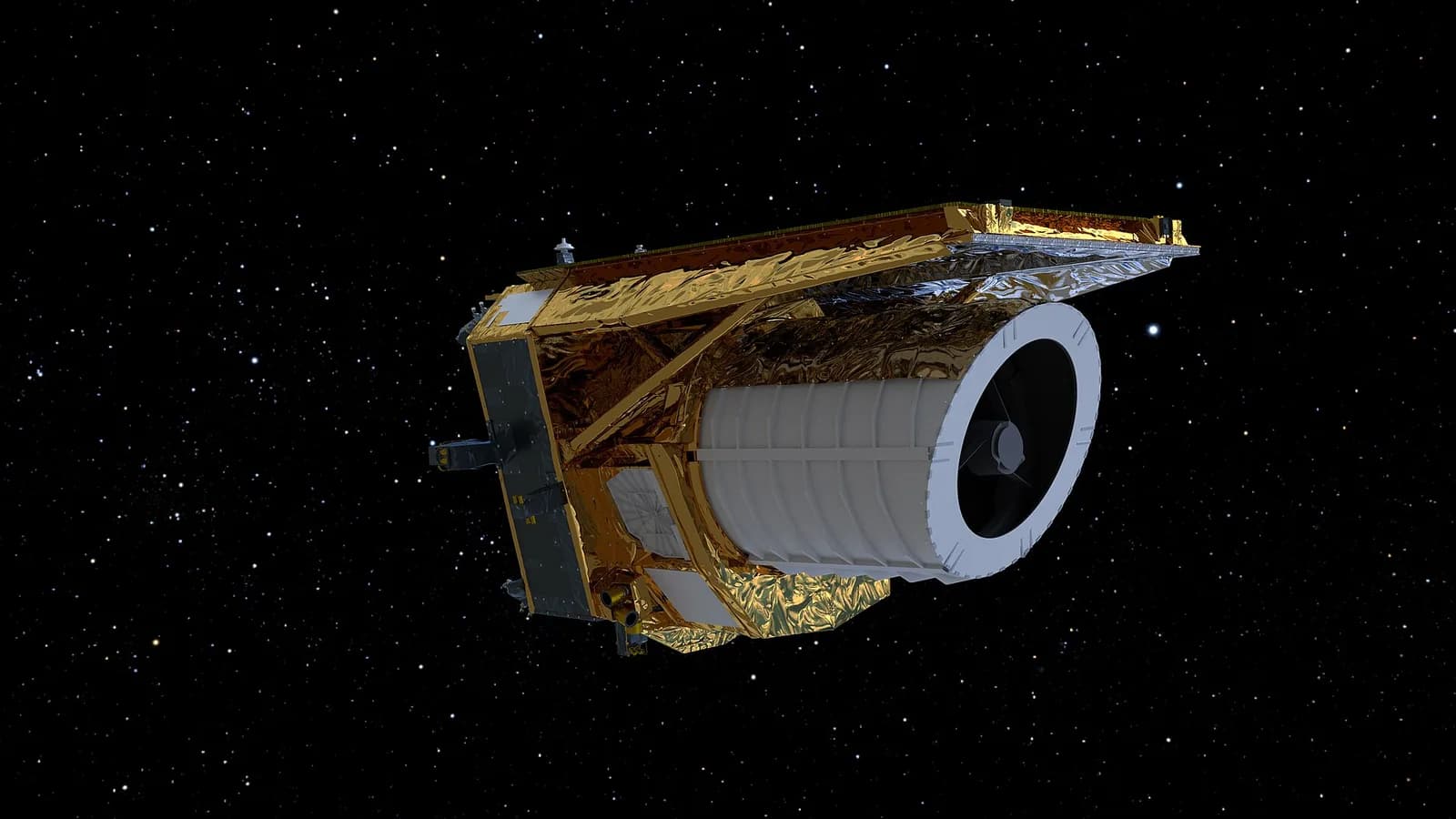
ESA's Euclid space telescope has found its first previously unknown comet, now designated C/2026 S1 (Euclid), the agency announced on October 19. The find is unusual because Euclid was built to photograph distant galaxies, and its survey is planned to stay away from the part of the sky where most comets and asteroids are seen.
The object turned up in images taken between September 16 and 24, 2026, and the International Astronomical Union's Minor Planet Center confirmed it as a comet on October 8.
A streak in a galaxy survey
The discovery came from Mikko Pöntinen, a doctoral researcher at Helsinki who works with the Euclid Consortium's Solar System Objects Science Working Group. He wrote software that searches Euclid's frames for things that move.
The program flagged a smeared trail crossing several images. By predicting where the object should be next, Pöntinen located it in five separate image sets, according to ESA. Those covered five fields of view in the Euclid Deep Field North, with two to four exposures each, 16 exposures in total.
A faint, fuzzy cloud around the object showed it was active, shedding dust and gas. Nothing in existing catalogues of comets and asteroids matched it, so it was reported to the Minor Planet Center as new.
"I was excited to see my software flag a 'streak' smeared across several images," Pöntinen said in ESA's release.
Why Euclid is a poor comet hunter
Euclid's job is to map billions of galaxies to study dark matter and dark energy. To get clean, deep images, it deliberately avoids the band of sky along the plane of the Solar System, where glare from interplanetary dust gets in the way. That band is also where most comets and asteroids appear.
The telescope also uses a "step-and-stare" pattern that visits each patch of sky only once. That meant the team could not point Euclid back at the comet to check its features. Bruno Altieri, a Euclid archive scientist on the discovery team, said in the release that very few comets are expected to be found by the mission.
C/2026 S1 is not in the usual band either. ESA says it is currently "straight up" from the Sun's point of view, well out of the plane of the planets, and about 1.3 billion km from Earth, roughly the distance between the Sun and the region of Jupiter's and Saturn's orbits.
A rehearsal for Comet Interceptor
ESA's interest goes beyond one object. The agency says the find suggests Euclid can pick up comets while they are still far from the Sun, which is the kind of early warning its future Comet Interceptor mission will need to pick a target.
This comet is not a suitable candidate for that mission, according to Altieri, but the alert gave the two teams a real case for practising how to coordinate.
What remains open is the orbit itself. ESA says one lap will take thousands of years, and the period will be refined as other observers collect more data.
Sources
- Euclid discovers new cometESAprimary source