NASA soldered a circuit board in orbit to test repair work in microgravity
The final MIYOKA experiment run will return an astronaut-soldered board to Earth for comparison with an identical sample assembled on the ground.
OddBrief EditorialAI-assisted, human-reviewed
 Science
Key facts
- Experiment
- MIYOKA lead-free soldering investigation
- Astronaut
- Anil Menon
- Location
- Harmony module aboard the ISS
- Next
- The circuit board will return to Earth for comparison
- Uncertainty
- Joint quality results have not yet been released
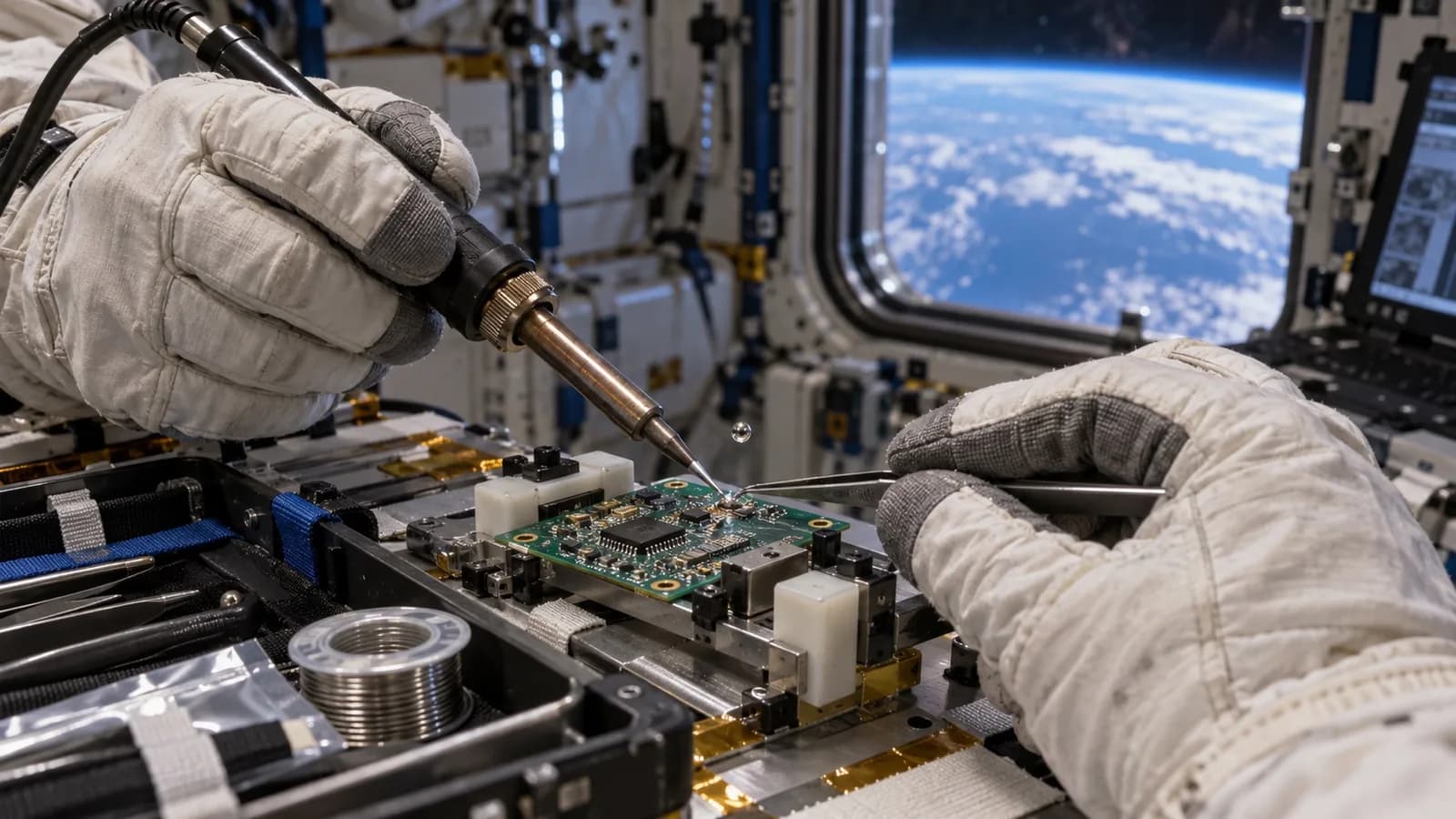
Astronaut Anil Menon has completed a small repair experiment with large implications: soldering a circuit board aboard the International Space Station. The board will return to Earth, where researchers will compare its joints with an identical sample soldered under normal gravity.
The September 18 run was the final session of the MIYOKA investigation. It used lead-free solder inside the station's Harmony module, testing whether crews can make reliable electronic connections when molten metal, gas bubbles and heat no longer behave as they do on the ground.
A basic skill becomes a physics problem
Soldering is routine on Earth. A technician heats a metal alloy until it flows across two components, then lets it cool into an electrical and mechanical joint. Gravity helps shape that flow and influences how bubbles and impurities move.
In orbit, surface tension dominates. Molten solder can form unexpected shapes, and trapped gas may remain in places that weaken a connection. A joint can look acceptable while hiding internal defects. That makes repair work risky for missions that cannot simply order a replacement part.
The MIYOKA board gives engineers physical evidence rather than a simulation. After the sample returns, researchers can cut, image and stress the joints, then compare their structure and conductivity with the ground control. NASA has not yet released the results, so the experiment does not establish whether orbital soldering is ready for routine use.
Repairs matter farther from Earth
The space station receives frequent cargo flights and can return hardware for analysis. A crew near the Moon or Mars will have fewer deliveries, longer delays and no easy route home for broken equipment. The ability to repair electronics could keep a navigation system, scientific instrument or life-support controller operating after a failure.
Lead-free solder is especially relevant because it is widely used in modern electronics. Its behavior differs from traditional tin-lead alloys, and reliability standards built around terrestrial manufacturing may not transfer cleanly to microgravity.
A workday built around future missions
Menon's soldering session was one part of a broader station schedule. Jessica Meir also performed a lunar landing simulation using hand controllers, a laptop and audio cues. The Manual Piloting study examines how microgravity and disorientation affect an astronaut's ability to control a lander.
The crew also prepared for the arrival of the Progress 96 cargo spacecraft, carrying nearly three tons of supplies. Together, the tasks show the station's less glamorous role as a workshop for future missions. Before crews can live farther away, they need to know whether familiar hands-on skills still work when gravity disappears.
Sources
- Week ends with soldering, lunar simulations, and cargo mission prepsNASAprimary source