Mars rover finds three watery chapters in rocks once mistaken for lakebed
Perseverance found volcanic rock altered by groundwater, a possible lake and later hot fluids on Jezero Crater’s rim.
OddBrief EditorialAI-assisted, human-reviewed
 Science
Key facts
- Location
- Jezero Crater Margin Unit
- Instrument
- Perseverance SuperCam
- Evidence
- At least three water-alteration episodes
- Limit
- The episodes cannot yet be dated; no life was found
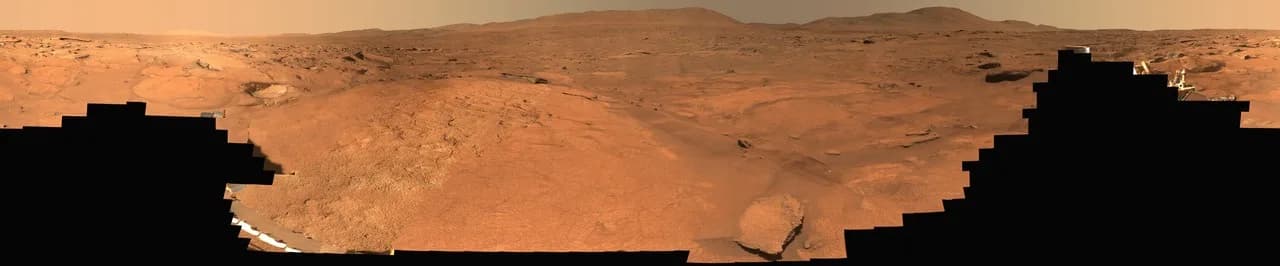
A stretch of rock on the rim of Mars' Jezero Crater has recorded at least three encounters with water, complicating a story that once looked like a simple ancient shoreline. NASA's Perseverance rover found igneous rock in the area called the Margin Unit, where scientists had expected sediment deposited beside a lake. The surprise matters because minerals in the rock preserve evidence of several distinct water systems.
NASA's Jet Propulsion Laboratory described the study on September 21. Researchers analyzed more than 185 bedrock targets across the unit with the rover's SuperCam instrument. Their interpretation points to groundwater, a possible lake episode and later hot fluids. It does not establish that life existed there, nor can the team yet date each water event.
A shoreline with a volcanic foundation
Jezero Crater held an ancient lake, and orbital observations showed carbonate minerals along its inner rim. On Earth, carbonates can form in watery settings capable of supporting life. Scientists therefore anticipated layers of sand, clay or silt, sedimentary rocks that can preserve biological traces.
Instead, Perseverance encountered coarse-grained igneous rock containing olivine. NASA says the rock formed in magma deep underground, cooled slowly and later became exposed by erosion. At higher elevations it shows little evidence of water alteration. Lower down, fractured olivine and minerals such as carbonate and silica tell a different story.
That contrast is useful. Rather than one uniform deposit, the terrain preserves a sequence of geological conditions at different heights. SuperCam fires a laser at distant targets and reads the light from the resulting plasma to identify chemistry; it can reach rocks up to 6.5 meters away. The rover's wider investigation covered roughly 265 meters of elevation.
Three visits by water
The researchers propose that carbon-dioxide-rich groundwater first reacted with olivine, leaving carbonate in fractures. A second episode may have involved the crater lake. Some lower rocks contain silica, consistent with further alteration of olivine in water. The third event produced mineral veins at an eastern site, including calcium sulfate and fluorite.
Fluorite is especially interesting because it can form when hot water moves through volcanic rock. The team takes it as a clue to a later heated groundwater system. These are interpretations of mineral evidence, not direct observations of ancient water flowing. The sequence is clearer than the timing: JPL says the researchers cannot yet assign ages to the three episodes.
On Earth, reactions between water and olivine can release hydrogen that certain microbes use, while carbonate and silica may preserve traces of life. That analogy explains why the Martian minerals are scientifically valuable. It is not proof of Martian microbes, and the article reports no detection of life.
A wider question for Jezero
The Margin Unit sits within one of Mars' largest carbonate exposures. Understanding how it formed could change interpretations of similar signatures elsewhere on the planet. It also shows why orbital clues need ground-level tests: a mineral seen from above did not identify which water system produced it.
Perseverance is collecting geological evidence and caching samples as part of its search for signs of past habitability. The new study adds a more complicated environmental history to that search. The rocks may preserve a record of multiple watery chapters; whether any chapter was inhabited remains an unanswered question.
Sources
- NASA Discovery Reveals Complex Water Systems on Early MarsNASA Jet Propulsion Laboratoryprimary source