Marine snow that is more viscous sinks farther and locks away more ocean carbon
A Science study maps the slime inside marine snow and finds its thickness decides how fast bacteria eat it and how deep its carbon goes.
OddBrief EditorialAI-assisted, human-reviewed
 Science
Key facts
- Who
- Scripps Institution of Oceanography (UC San Diego) and the University of Lincoln
- What
- more viscous marine snow resists bacteria, sinks farther and stores more carbon
- Number
- modeled high-viscosity particles carry more than six times the carbon of low-viscosity ones
- Context
- of more than 10 gigatons of sinking carbon a year, only about 2 are stored long term
How gooey a clump of marine snow is helps decide whether its carbon ends up stored in the deep ocean or released near the surface, according to a study published October 8 in Science. Researchers at UC San Diego's Scripps Institution of Oceanography and the University of Lincoln found that more viscous clumps resist bacteria longer, sink farther and contribute more to carbon storage.
The finding offers one explanation for a long-standing gap in the ocean's carbon budget: most of the carbon that starts sinking never gets deep enough to stay there.
Most sinking carbon never reaches storage
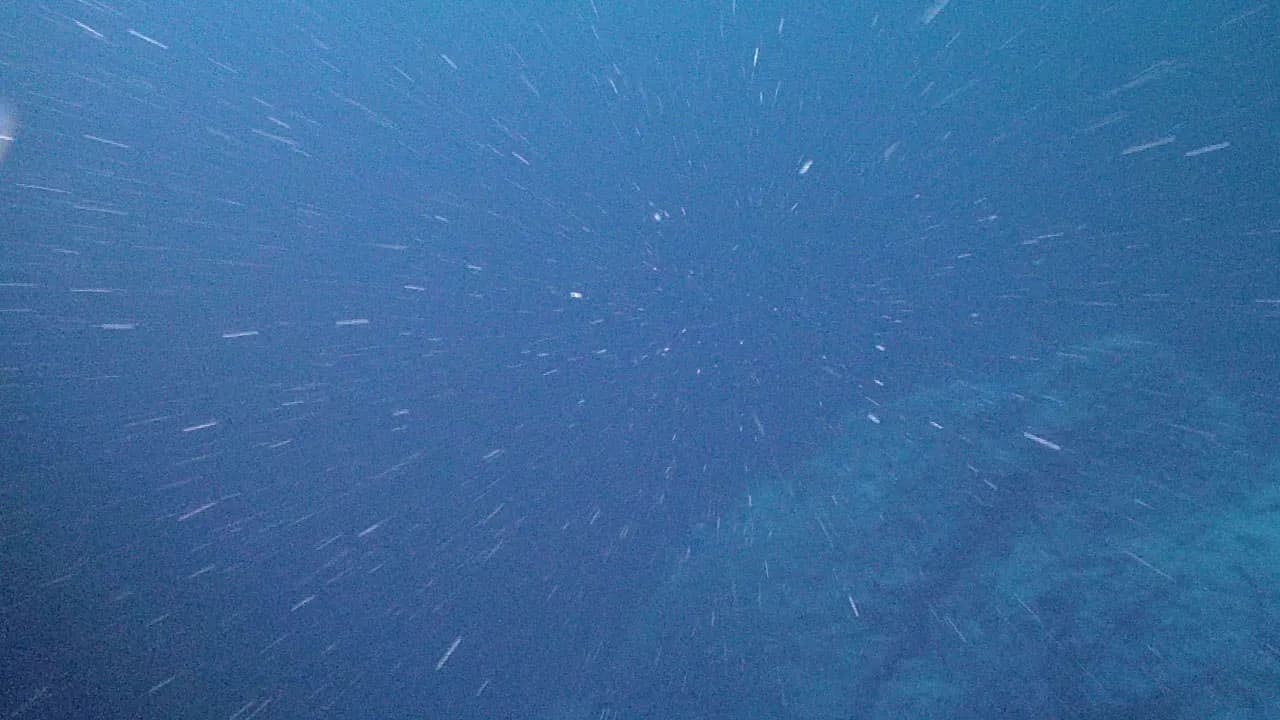
Marine snow is the steady fall of organic debris from the sunlit ocean: dead plankton, fecal pellets, mucus and silt stuck together in small clumps. According to Scripps, these particles move upward of 10 gigatons of carbon out of surface waters each year, by scientists' estimates.
Only about two gigatons of that are thought to sink deep enough to be held for hundreds to thousands of years. The rest is broken down by bacteria on the way, and the carbon returns to the water. Why so little makes it has been an open question.
A map of the slime, at bacterial scale
The team, Bryce Inman, Stuart Humphries and Farooq Azam, used molecular rotors, fluorescent molecules whose glow changes with the stiffness of their surroundings, together with 3D confocal microscopy. That let them measure viscosity across individual natural clumps at a scale smaller than a bacterium.
The clumps turned out to be highly structured. Their outer regions were less viscous and easy for bacteria to colonize, while thicker regions inside acted as a barrier that bacteria could not enter until they had broken down the material around them. Inman compared it to a worm in an apple, where the flesh is easy to get through but the core is not.
Inman said the work took years of failed attempts before the imaging method worked in 2025. A companion paper in Nature Communications describes the technique. According to Scripps, this is the first time living bacteria have been observed moving through the physical structure of marine snow, or of mucus in general.
Thicker clumps last longer and go deeper
In laboratory experiments, more viscous clumps took longer for bacteria to degrade and break apart. Computer simulations then suggested that the more viscous a clump is, the deeper it sinks before it is consumed.
From those results, the team calculates that the thickest particles may deliver over six times as much carbon to the deep ocean as low-viscosity particles. That figure comes from modeling, not from measuring particles at depth.
The study adds a physical limit, set at the scale of single microbes, to models of the ocean's biological carbon pump. The authors also expect the imaging method to be useful beyond the ocean, since coral reefs, plant roots and animal guts all depend on bacteria living in mucus.
What the study does not yet say is how much of the global gap between 10 and 2 gigatons viscosity explains. Testing that will require measuring the viscosity of marine snow in the open ocean at much larger scale.
Sources
- Marine snow viscosity regulates microbial degradation and the ocean carbon sinkScienceprimary source
- The gooier marine snow is, the better it is at transporting carbon, new study findsScripps Institution of Oceanography