Hubble found a spiral galaxy whose center rotates sideways
NGC 4698 has a central bulge that turns almost perpendicular to its outer disk, likely preserving evidence of an old merger or gas capture.
OddBrief EditorialAI-assisted, human-reviewed
 Science
Key facts
- Galaxy
- NGC 4698
- Distance
- About 55 million light-years
- Environment
- Virgo Cluster
- Oddity
- Central stars and gas rotate nearly perpendicular to the outer disk
- Likely cause
- External gas accretion or a past minor merger
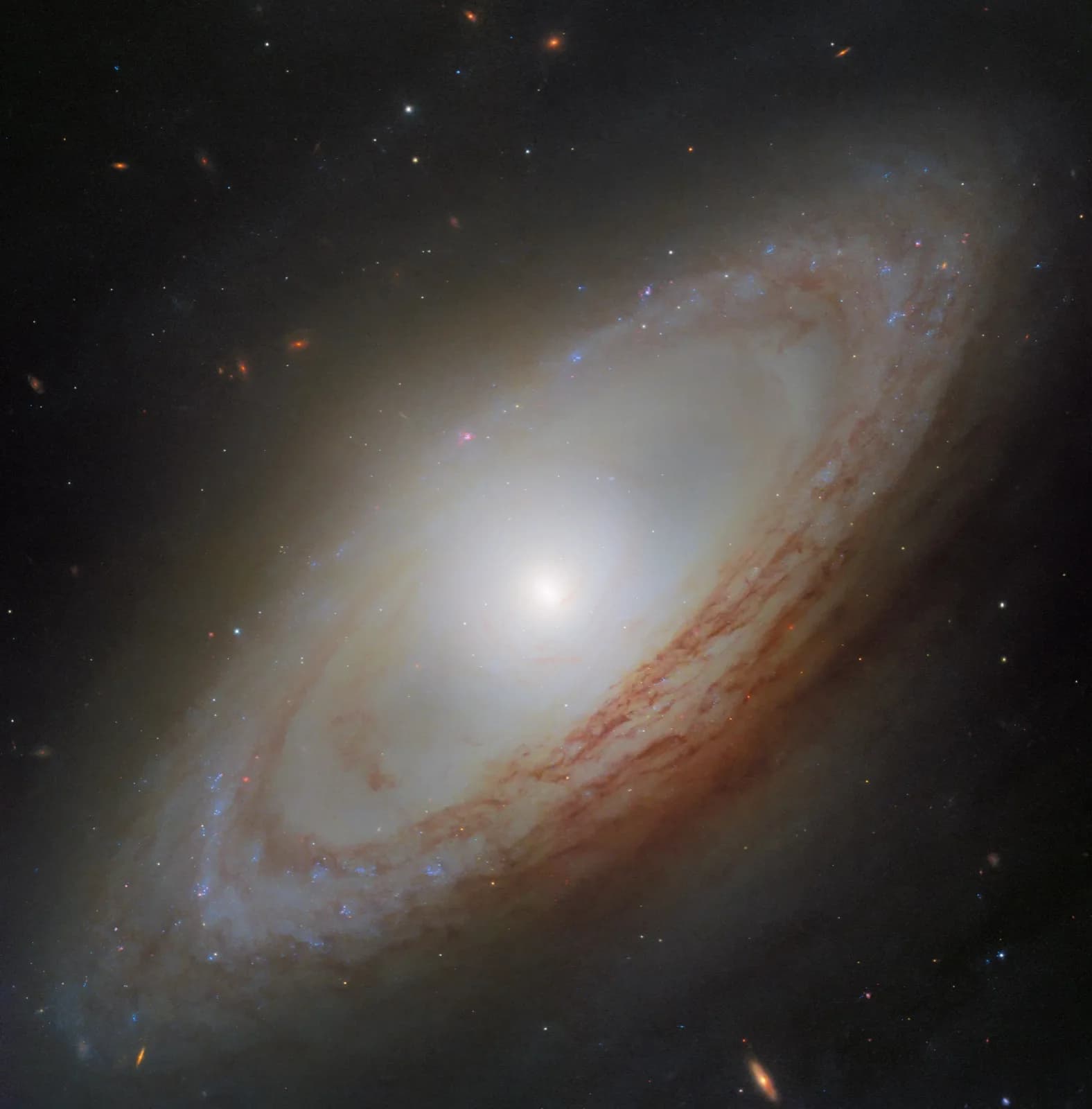
A spiral galaxy in the Virgo Cluster appears to have been assembled from parts that never agreed on which way to turn. New Hubble observations of NGC 4698 show a central bulge rotating almost perpendicular to the galaxy's outer disk.
The galaxy sits about 55 million light-years away in a cluster containing more than a thousand galaxies. From a distance it resembles a normal spiral, but its arms are concentrated in an outer disk and ring while the elongated center points across them at nearly a right angle.
Two axes inside one galaxy
In most spiral galaxies, stars in the central bulge and material in the disk orbit around roughly the same axis. NGC 4698 breaks that pattern. Stars and gas near its center move in a plane that is close to perpendicular to the surrounding disk.
Hubble's detailed view does not create the kinematic measurement by itself, but it reveals the structure that accompanies it. The central region looks embedded sideways inside the larger spiral, giving astronomers a visible record of an unusual formation history.
The leading explanation is that NGC 4698 acquired material from outside. It may have absorbed a smaller galaxy or captured a large stream of gas whose angular momentum pointed in a different direction. That incoming material could have formed the orthogonal center while the older disk kept its original rotation.
A hydrogen tail strengthens the case
Astronomers have also detected an extended tail of neutral hydrogen associated with the galaxy. Such tails often appear when gravity pulls gas during an encounter or when material is stripped and later accreted.
The tail does not identify a single culprit or date the event. Galaxy clusters are crowded environments, and several interactions can reshape a system over billions of years. The current image is therefore evidence of a complicated past rather than a frame-by-frame reconstruction.
NGC 4698's geometry may also affect how gas reaches its nucleus and how stars form across the disk. Material moving on crossed orbital planes can collide, lose energy and fall inward, though the new release does not claim a direct measurement of that process.
A fossil hidden in rotation
Galaxies preserve history in the motion of their stars. Light can fade and tidal debris can disperse, but a large population rotating on a different axis may survive long after the event that placed it there.
The Hubble image was produced through the MAUVE-HST program, which examines ultraviolet properties of nearby galaxies. In NGC 4698, the striking shape gives that broader survey a particularly clear target.
A galaxy that looks serene can carry two incompatible rotations at once. Its sideways center is a reminder that spirals are not built in isolation; they grow by collecting material, and sometimes the new pieces keep the direction they arrived with.
Sources
- NASA’s Hubble spots an out-of-sync galaxyNASAprimary source