Sheffield remade the Lycurgus Cup's color-shifting Roman glass, with a nuclear waste link
A University of Sheffield technician found a repeatable recipe for the color-shifting glass of a 4th-century Roman cup, after trials that even included sugar.
OddBrief EditorialAI-assisted, human-reviewed
 Culture
Key facts
- Who
- Dr Lisa Hollands, University of Sheffield
- What
- a repeatable recipe for the Lycurgus Cup's dichroic glass, made in quantity
- Show
- a sculpture by Elliot Walker at Festival of the Mind, November 6 to 15, 2026
- Next
- the findings feed photonic materials and nuclear waste glass research
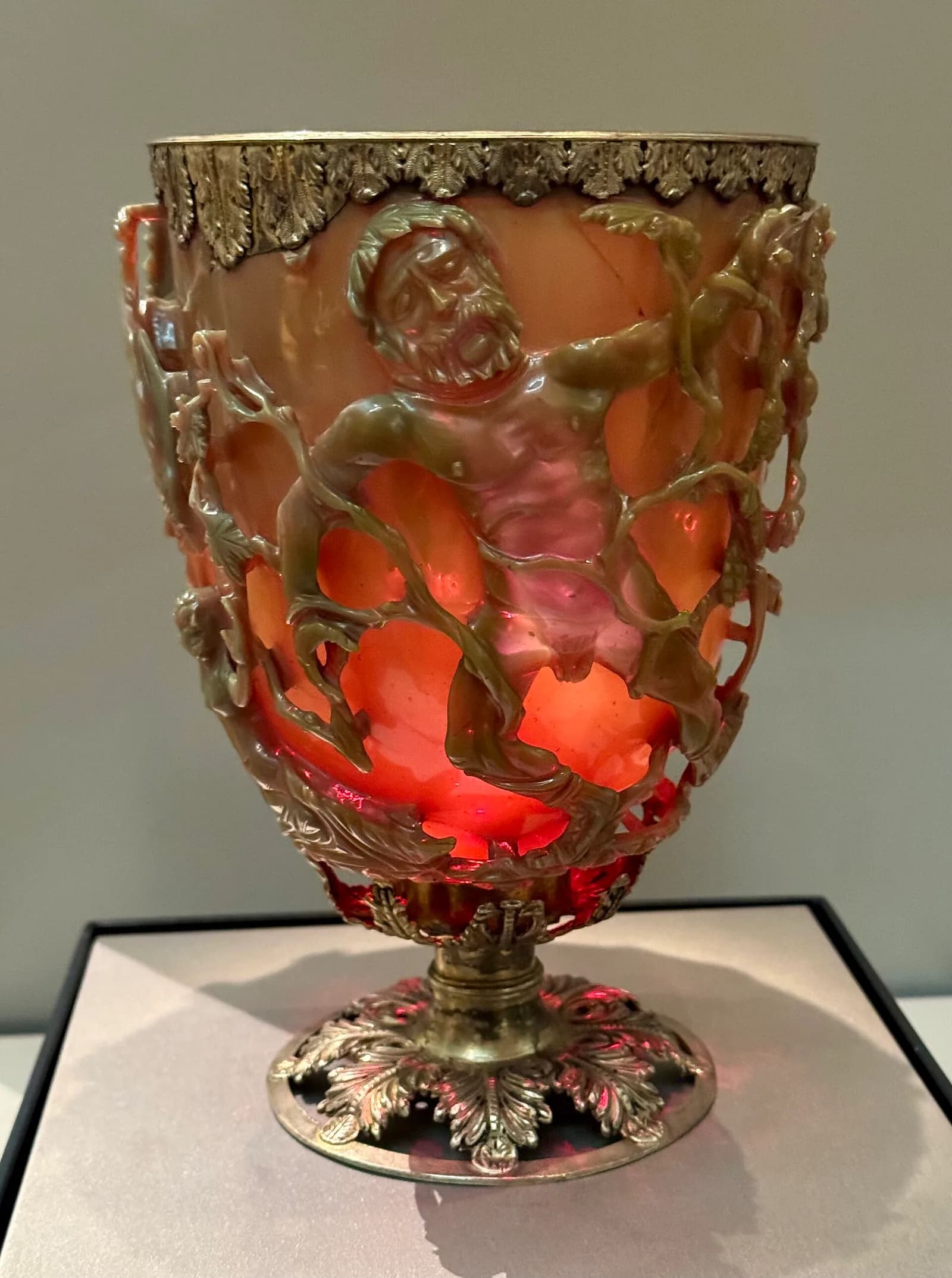
A technician at the University of Sheffield has produced, in quantity, the color-shifting glass of the Lycurgus Cup, a 4th-century Roman vessel in the British Museum that looks jade green when lit from the front and ruby red when light passes through it. The university announced the result on October 26 and says it is the first time the effect has been reproduced in quantity in 1,600 years.
The glass is not only a museum curiosity. According to the university, what the team learned will inform new photonic materials as well as glasses used to lock away radioactive waste.
Why the recipe was hard to pin down
The cup's trick is called dichroism. Experts believe the Roman makers added tiny amounts of gold and silver that formed nanoparticles far smaller than the wavelength of light, so the glass absorbs and scatters light differently depending on where the light comes from. Earlier attempts reproduced the effect with mixed success, but a consistent, repeatable recipe stayed out of reach, the university says.
Dr Lisa Hollands, from the School of Chemical, Materials and Biological Engineering, built on a recipe worked out from a surviving fragment of the original glass. With Roman glass specialist Professor Caroline Jackson, she first built a base glass from modern materials meant to behave like the Roman one.
The harder step, Hollands said, was "trying to get small amounts of gold and silver into the glass in the right form." She varied furnace types, starting materials and oxygen levels across many experiments, and at one point tried adding sugar, before landing on a glass that looked opaque green under front lighting and turned red when lit from behind. The university has not published the exact proportions.
From a festival dare to a sculpture
The project began as a challenge from Christina Metcalfe, manager of the Molecular Photonic Breadboards project, for Sheffield's LightFest in 2025. That project, a partnership with the University of Bristol paid for by the Engineering and Physical Sciences Research Council, designs light-handling materials for areas such as solar energy and quantum technology.
Glass artist Elliot Walker then used the Sheffield glass to make a sculpture that blends the Lycurgus story with the Farnese Atlas, swapping the globe for a cup. It goes on show at the Millennium Gallery during Sheffield's Festival of the Mind from November 6 to 15, 2026, then moves permanently to the university's Turner Museum of Glass.
The quiet link to nuclear waste
The work connects to Professor Russell Hand's research in Sheffield's Immobilisation Science Laboratory, which seals complex nuclear wastes inside glass. Knowing what makes crystals form inside a glass helps decide how much waste can be safely packed into it, the university says.
Only 40 glass cage cups survive from that era, and the Lycurgus Cup is the only one with this color change. How the Romans themselves controlled the process remains unknown.
Sources
- Technician cracks 1,600-year-old mystery to replicate Roman masterpieceUniversity of Sheffieldprimary source