Google Research's lab agents chased sticky DNA binders until specificity fell to 19%
In a robot-run aptamer trial, Google's AI agents first rewarded raw binding strength, filled a round with promiscuous G-quadruplex designs, then fixed their own rules.
OddBrief EditorialAI-assisted, human-reviewed
 AI
Key facts
- Who
- Google Research, with its VERID lab digital twin
- What
- AI agents designed and tested DNA aptamers over three robot-run rounds
- Catch
- a round dominated by sticky G-quadruplex designs cut specificity from 75.0% to 19.1%
- Recovery
- revised rules lifted the on-target hit rate ninefold to 33.5%
Google Research says AI agents running its robotic wet lab fell into a classic trap in an October 16 write-up: chasing raw binding strength, they filled a round of DNA aptamer designs with "sticky" sequences that grabbed almost anything, and specificity for the target protein dropped from 75.0% to 19.1%. In the next round the agents changed their own design rules and recovered.
The episode is the most concrete part of a broader report on letting software agents plan, run and learn from real lab experiments rather than only design molecules on a computer.
How the sticky round happened
The test bed was aptamers, short DNA strands that fold into shapes able to bind a protein. They are cheap to make and quick to read out by sequencing, so a full design, test and analysis cycle takes 7 to 10 days, according to Google. The agents ran three such cycles against two targets, the muscle protein myoglobin and the blood clotting enzyme alpha-thrombin.
On myoglobin, the agents' second round leaned heavily on G-quadruplex motifs, a guanine-rich fold that made up 63% of the designs. Those strands bound strongly, but much of that binding was to the wrong things, including off-target proteins and the bare beads used in the assay. Once bead binding was subtracted, the true hit rate fell from 10.2% to 3.7%.
For round three, the agents capped promiscuous motifs, subtracted bead binders from their scoring and moved to scaffolds that were not G-quadruplexes. Google reports that the on-target hit rate rose ninefold to 33.5% and specificity came back to 72.4%.
A different failure on the second target
Alpha-thrombin went wrong for another reason. In round one, fixed primer overhangs, the sequence tails needed for the lab chemistry, disrupted folding in 48% of the designs, and the round produced no binders at all. Clamping those tails into stems fixed the problem: hit rates reached 26.0% in round two and 42.1% in round three, at 98.5% specificity.
Google frames both cases as the agents learning from their own mistakes, but they also show the open problem it names: making sure an optimizer rewards real target binding rather than a shortcut in the experiment.
Keeping a robot from doing something impossible
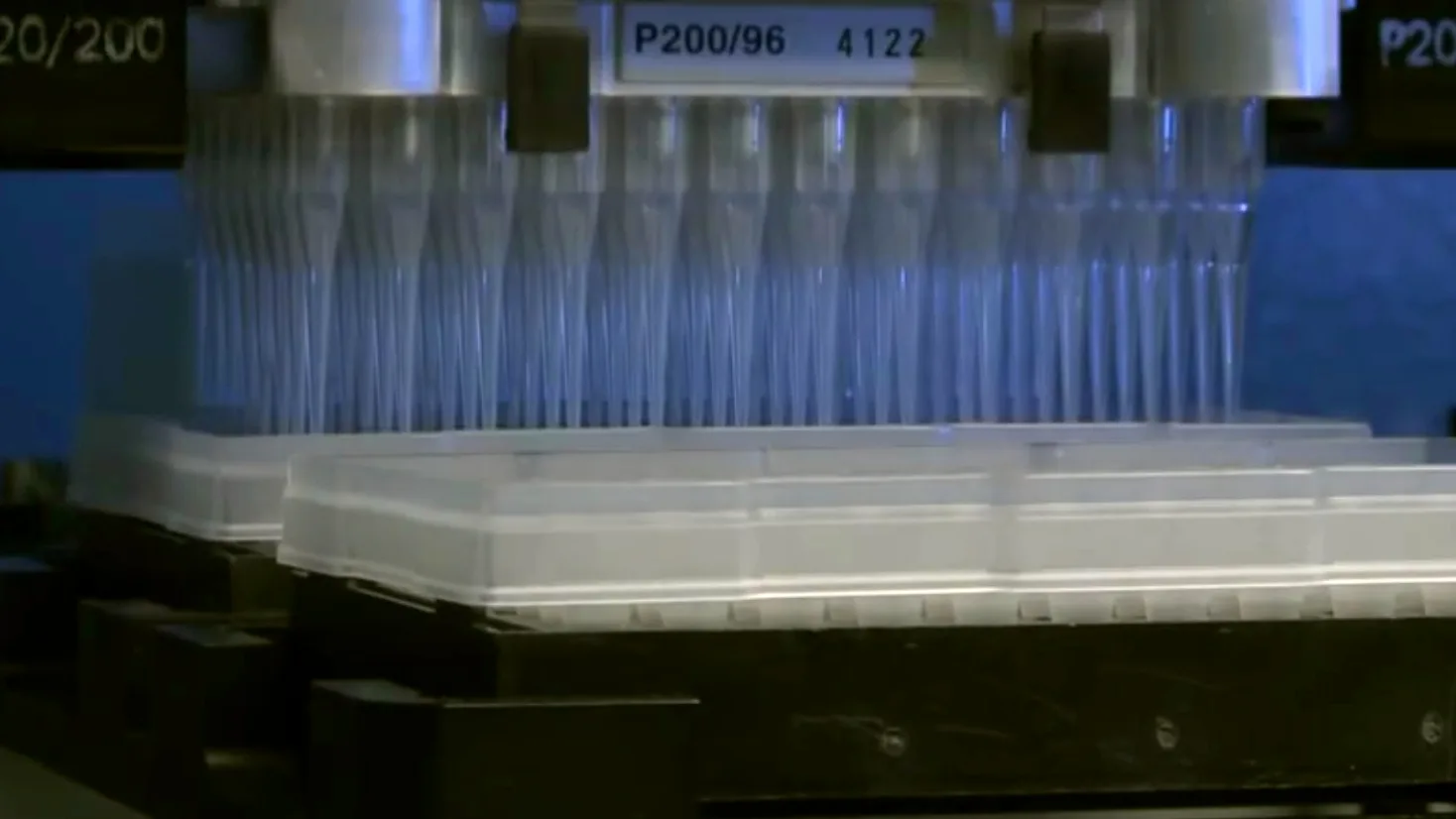
The lab side runs on a system Google calls VERID, a digital twin of the robotic workcell built on the open-source PyLabRobot framework. It tracks arm positions, well volumes, reagents and pipette tips, simulates a protocol in seconds and blocks commands the hardware cannot carry out.
In one case it refused an eight-channel move that was too wide for a narrow trough. Forced to rethink, the agent designed a diagnostic run that exposed a small bias from liquid clinging to tip walls. In a self-play task where it reconstructed hidden dye mixtures from camera images, the agent improved its accuracy more than fivefold, Google says.
A separate protein design project targeting FAP, a receptor common in solid tumors, found that a scientist directing an agent nearly doubled the computational hit rate of a scientist working alone at equal compute. Google did not publish the exact binding values or binder counts, and it says every designed sequence went through biosecurity screening and human review.
Sources
- Grounding AI agents in biological reality: Building blocks for autonomous wet labsGoogle Researchprimary source
- PyLabRobotGitHub