Microsoft's Copilot wants to keep working after you leave
Microsoft announced a new Copilot layout with a place to build small apps and an agent designed to continue tasks in the cloud. Most of it is still on a staged rollout.
OddBrief EditorialAI-assisted, human-reviewed
 AI
AIKey facts
- Fact 1
- Microsoft announced Home, Code and Autopilot on September 25
- Fact 2
- Autopilot is designed as a persistent cloud-hosted agent
- Fact 3
- Home and Code are in staged Frontier rollout
- Fact 4
- Autopilot private preview is planned for late September
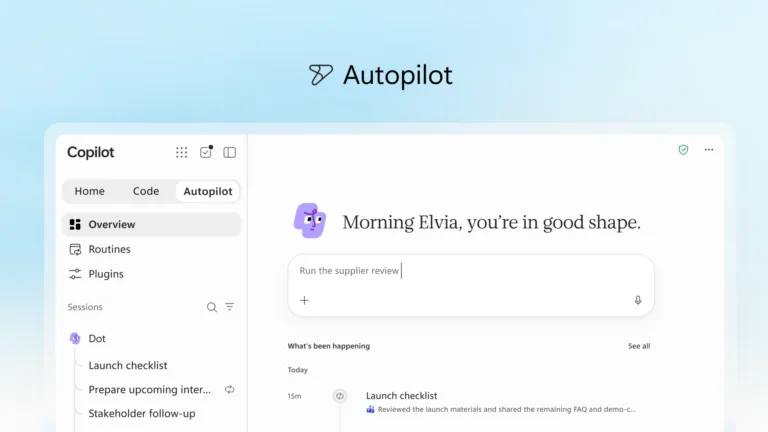
On September 25, Microsoft described a Copilot app organized around Home, Code and Autopilot. The last of those is the unusual part: a persistent agent with its own identity, memory, computer and workspace inside a customer's Microsoft 365 environment. It is intended to follow work across Teams, Outlook and documents, even when the person who assigned it is away.
A colleague with a workspace
Home combines Chat and Cowork, Microsoft's task-delegation experience, with Word, Excel and PowerPoint inside Copilot. A user could ask for an editable document or workbook, then refine it alongside the conversation. Microsoft says collaborators' edits remain synchronized with the familiar Office apps.
Code is aimed at people who need a small tracker, dashboard, automation or internal app without starting in a traditional development environment. It uses technology related to GitHub Copilot. Microsoft's Managed Runtime is meant to host those creations within a company's tenant, where IT can govern them and staff can share them. The runtime is already in preview, according to Microsoft.
Autopilot goes a step further. Rather than wait for each prompt, Microsoft says it can monitor channels, follow up on threads and resume recurring work days later. The company gives a supplier review as an example: planning meetings, preparing material and asking stakeholders for updates. It says a user sets the objective and boundaries, with permissions and auditing around the agent's actions.
That design changes the practical question from whether an AI can answer well to what authority a long-running agent receives. An agent that can keep working through messages and files also needs clear limits, a reliable record of its actions and a way for a person to intervene. Microsoft describes governance tools, but this announcement does not show how the system performs across ordinary organizations or difficult edge cases.
Availability is the catch
Home and Code are due to start rolling out through Microsoft's Frontier program in the coming weeks. The company says Autopilot will expand to private preview at the end of September. Broader availability and real-world reliability remain to be demonstrated.
Microsoft also announced more business context from Fabric, Dynamics 365 and Power Platform, and a plugin registry that IT teams can approve centrally. Those additions could give the new agent more useful information and actions. They also make the boundary between assistance and independent execution more consequential.
For now, this is an architecture and rollout announcement, not evidence that every Microsoft 365 user has a tireless digital coworker today. The next test is whether people can understand, supervise and correct what that coworker actually does.
Sources
- Introducing the new Copilot with Home, Code and AutopilotMicrosoftprimary source