Stanford’s Paper2Agent turns Nature papers into virtual corresponding authors
A peer-reviewed Nature paper from Stanford describes Paper2Agent, which builds MCP servers from a manuscript and code so chat agents can rerun methods and answer new queries. An AlphaGenome agent spun up in about 45 minutes for roughly $14 and beat other biomedical agents given the same paper access.
OddBrief EditorialAI-assisted, human-reviewed
 Science
Key facts
- Published
- Nature 16 Sep 2026, open access DOI 10.1038/s41586-026-11044-y
- Method
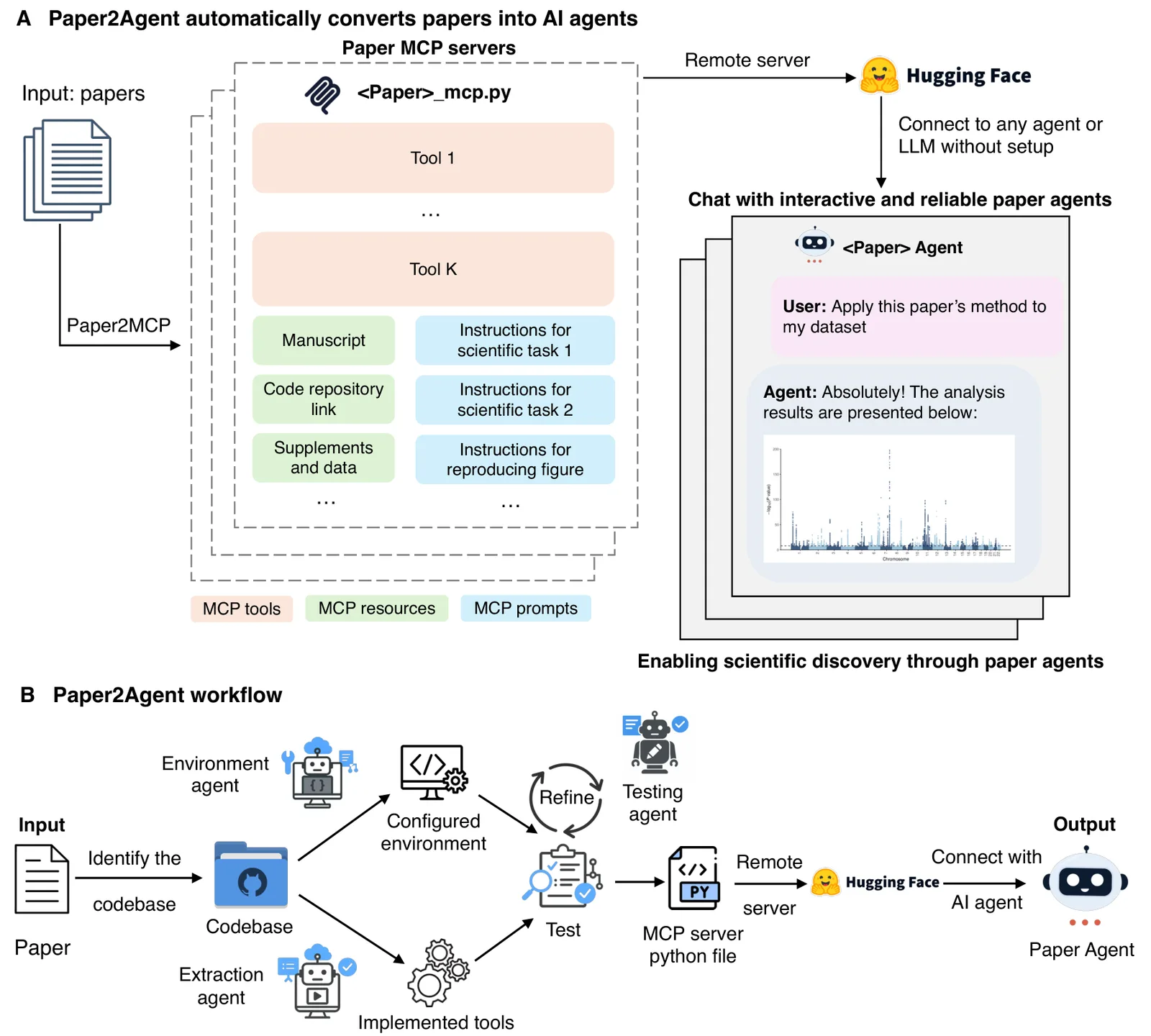
- paper and code to MCP server; automated tests and refinement; chat-agent connection
- Cases
- AlphaGenome, Scanpy, TISSUE; multi-agent psoriasis causal-gene collaboration
- AlphaGenome build
- about 45 minutes, about $14 compute; 22 MCP tools; outperformed Claude+Repo and Biomni
Most papers still die as PDFs. Stanford researchers want them to answer email. In a Nature article published 16 September 2026, Jiacheng Miao, Joe R. Davis, Yaohui Zhang, Jonathan K. Pritchard, James Zou and colleagues introduce Paper2Agent, an automated pipeline that converts a research paper and its codebase into an AI agent that behaves like a virtual corresponding author. The pitch is not autonomous discovery theater. It is reuse: stop forcing every new reader to reverse-engineer someone else’s scripts.
From static artifact to MCP tools
Conventional articles bury methods in supplements and repos that only specialists can operate. Paper2Agent analyzes the manuscript and code with multiple agents, constructs a Model Context Protocol (MCP) server that exposes the paper’s tools and workflows, then generates and runs tests to harden that server. Once built, the MCP can plug into a chat agent such as Claude Code. A scientist asks in natural language. The system invokes the paper’s own methods, data hooks, and visualizations rather than hallucinating a paraphrase of the abstract.
The team’s case studies stay inside computational biology, where code and notebooks already travel with the text. Paper2Agent produced agents for AlphaGenome (genomic variant interpretation), Scanpy (single-cell analysis), and TISSUE (spatial transcriptomics with uncertainty estimates). The authors report that the agents can reproduce original results and handle novel user queries. In a multi-agent demo, several paper agents collaborated to prioritize a causal gene for psoriasis, a glimpse of what Zou has called an ecosystem of AI co-scientists.
Forty-five minutes and fourteen dollars
The showpiece is AlphaGenome. Nature’s news coverage and the paper both describe Paper2Agent autonomously generating an AlphaGenome agent in about 45 minutes for roughly $14 of compute on a personal laptop, without human intervention for that build. The run produced 22 MCP tools that passed automated validation, spanning variant scoring, sequence-level prediction, tissue ontology exploration, and visualization. Benchmarks in the paper put the Paper2Agent AlphaGenome agent at about 82.7 percent accuracy versus lower scores for a Claude-plus-repository baseline and the Biomni biomedical agent, with faster median runtimes on both tutorial-derived and novel queries.
That cost curve is the odd brief. Building a reusable “paper employee” once, then querying it repeatedly, is a different economics from re-prompting a general model against a raw GitHub dump every time a lab rotates a new student onto a method.
Co-scientists, not autopilots
The authors and Nature’s accompanying pieces are careful about the ceiling. These agents re-execute and recombine published tooling. They do not replace experimental judgment, clinical decisions, or the messy work of deciding which question is worth asking. Zou has argued the format can reimagine what knowledge looks like by making papers interactive and easier to approach from outside a subfield. The psoriasis and genomics examples show collaboration across agents, and even disagreement with a paper’s own highlighted causal-gene story when the underlying tools support more than one reading.
For journals and funders, the implication is awkward in a productive way. If a paper can be compiled into a tested tool server, “code available upon request” starts to look like a broken build. Paper2Agent does not abolish the human corresponding author. It drafts a tireless understudy that already knows where the methods section hid the real instructions.
Sources
- Reimagining research papers as interactive and reliable AI agentsNatureprimary source