In Bristol, a Wooden Temple Tolls for the Extinct
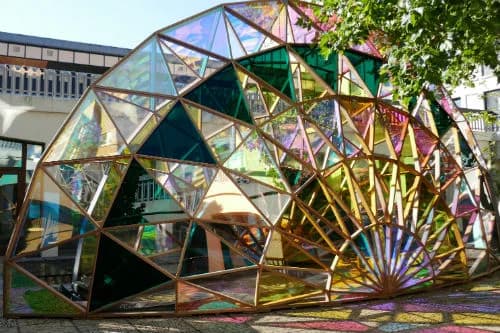
Outside the University of Bristol's chemistry building stands a structure that looks like two giant palms pressed together in prayer, built from spiralling wood and dichroic glass. Inside, a bell rings up to 200 times a day, each toll marking an estimated species lost to extinction somewhere on Earth that day.
OddBrief EditorialAI-assisted, human-reviewed
 Culture
Bristol is not short on churches, but the city's most unusual devotional structure is dedicated to nature rather than any deity. It sits outside the University of Bristol's School of Chemistry, and at first glance it could be mistaken for the set of a science-fiction film. Look closer, and it resembles two enormous hands pressed together in prayer, rendered entirely in curved wood and colored glass.
The piece is called the Palm Temple, and it is the work of British artist Luke Jerram, a man with a habit of turning scientific unease into public art. He built it in 2020 to mark the 600th anniversary of Brunelleschi's dome in Florence, a structure that itself was considered an engineering impossibility in its day. After touring various sites, the Palm Temple found a permanent home in Jerram's native Bristol, where he donated it to the university that now hosts it on its front lawn, presumably between lectures on molecular structure and thermodynamics.
The architecture itself is a small trick of the eye. Two spiralling wooden domes are positioned facing one another, creating an optical illusion that reads, from most angles, as a single pair of palms in prayer. The panels fitted between the wooden ribs are dichroic, meaning they shift color depending on the angle of light hitting them, so the building never looks quite the same twice. A mirrored floor beneath the structure reflects the sky, the weather, and the building above, doubling the effect and making the whole thing feel less like a fixed object and more like a slow-motion kaleidoscope. At night, it is lit from within and glows like a lantern on the university lawn, which is either serene or slightly ominous depending on one's mood.
The temple's quieter and more unsettling feature hangs inside it: a piece Jerram calls the Extinction Bell. It rings at random intervals, somewhere between 150 and 200 times over the course of a day. Each ring is meant to represent one species going extinct somewhere in the world within a 24-hour period, a figure drawn from widely cited (if inherently imprecise) estimates of biodiversity loss. There is no fixed schedule, no countdown, nothing to brace for. The bell simply tolls whenever it tolls, which is presumably the point. Extinction, after all, does not wait for a convenient hour.
This is where the Palm Temple stops being merely decorative and starts functioning as something closer to a public service announcement, albeit one delivered through architecture rather than a pamphlet. Visitors wandering in expecting a pleasant photo opportunity may instead find themselves standing under a structure that is, in effect, keeping score of a crisis most people would rather not think about while on a lunch break. The prayer-like form only sharpens the discomfort, since prayer is traditionally what people do when they want something to change and lack the means to change it themselves.
Jerram has built a career on this kind of quiet provocation. He is also responsible for giant inflatable planets that tour cathedrals and public squares, and other installations that take enormous, abstract subjects and make them physically confront the public in ordinary spaces. The Palm Temple fits that pattern precisely: a chapel-shaped object, on a university lawn, ringing a bell for creatures that will never know they were mourned.
What makes the structure genuinely strange is how many registers it operates on simultaneously. It is a piece of architectural sleight of hand, using two matching wooden spirals to trick the eye into seeing praying hands. It is a nod to Renaissance engineering, referencing a 600-year-old dome most visitors will never have seen in person. It is a functioning kaleidoscope, changing with cloud cover and sunlight. And it is, somewhat incongruously, an alarm system for planetary loss, disguised as a place of contemplation.
The Palm Temple remains open to visitors, weather and university schedules permitting, and it continues to shift its appearance throughout the day without any assistance from its creator. Those who linger long enough will eventually hear the bell. There is no way to predict exactly when, which seems appropriate, since neither can biodiversity loss itself. Bristol has plenty of remarkable buildings and no shortage of street art, but this may be the only structure in the city that asks visitors to stand still and listen for bad news, wrapped, admittedly, in something quite beautiful to look at.
Sources
- Palm Temple in Bristol, Englandkaynakprimary source