How the Buddha Became a Christian Saint (Twice)
A widely shared piece traces how the life story of the Buddha slipped into Christian hagiography, producing two sainted figures whose biographies are, on close inspection, the Buddha wearing a halo.
OddBrief EditorialAI-assisted, human-reviewed
 Culture
Somewhere between the fifth and ninth centuries, a story that began under a fig tree in northern India ended up in the calendars of Christian saints, translated, retranslated, and lightly rebranded along the way. According to an article that has been making rounds this week, at least two Christian saints owe their entire narrative arc to the life of Siddhartha Gautama.
The mechanism was not mysterious, just long. The Buddha's biography traveled west along trade routes through Persian and Arabic intermediaries, picking up new names and a thin coat of monotheistic varnish at each stop. A prince who renounces wealth, encounters suffering, and retreats from the world is a strong story regardless of the theology attached to it, and strong stories tend to survive translation even when their metaphysics do not.
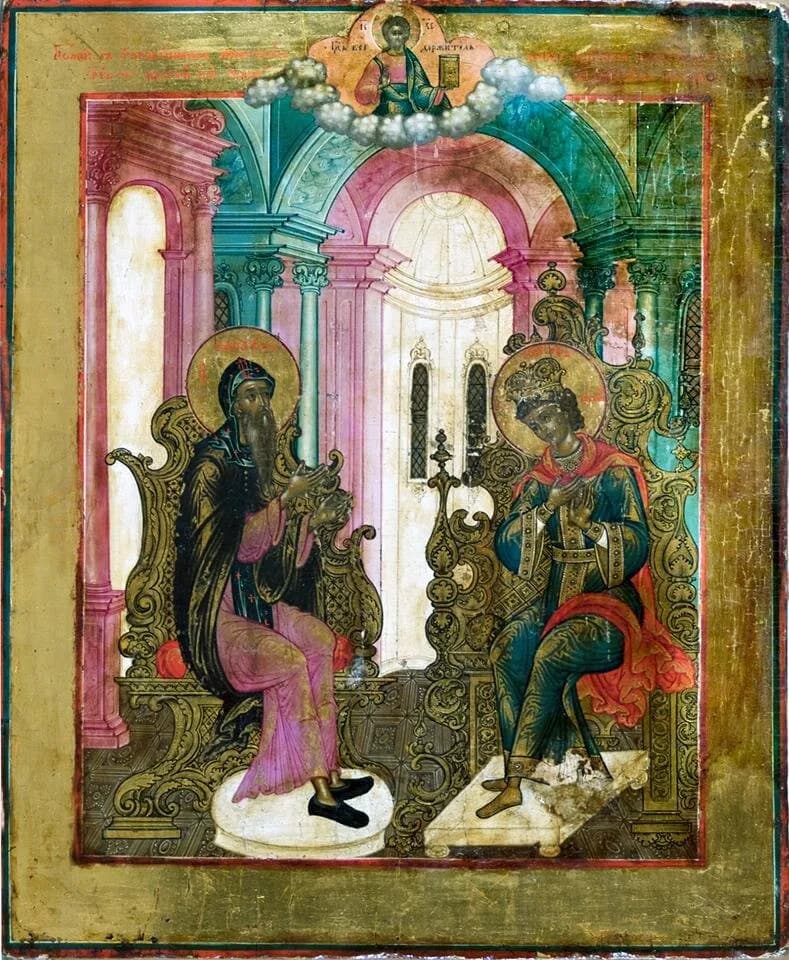
The most cited case is Saint Josaphat, whose legend is essentially a word-for-word transplant: a sheltered prince, a father who tries to shield him from the sight of suffering, and an eventual awakening that sends him away from the throne entirely. Scholars have long noted the parallel to the Buddha's own sheltered youth and departure from his father's palace, but the article's contribution is less about proving the connection, which is not new, and more about tracing exactly how the corruption of names occurred: Bodhisattva became, through a chain of transliterations across Persian and Georgian sources, something that eventually reads as Josaphat in Latin. It is less a metaphor than a paper trail.
The second figure is treated more cautiously. The parallels are structural rather than nominal, a set of narrative beats, the renunciation, the temptation, the retreat into asceticism, that echo the Buddha's story closely enough to raise eyebrows, without the same tidy etymological smoking gun. The article is careful to flag this distinction, and the discussion that followed largely respected it, with several commenters pointing out that shared narrative bones do not necessarily mean shared authorship.
Why this is strange is worth sitting with for a moment. Buddhism and Christianity disagree about nearly everything that matters theologically, whether there is a creator god, whether the self persists, what suffering means and what should be done about it. A story engineered for a tradition built on the cessation of desire and the illusion of the self was absorbed, with only cosmetic edits, into a tradition built on a personal creator and eternal salvation. The transplant worked because medieval hagiography was not especially concerned with theological consistency between sources. Scribes copying edifying tales from foreign manuscripts were interested in a good renunciation story, not in auditing it for compatibility with dogma. The result is a filing error that lasted over a thousand years, hiding in plain sight in liturgical calendars.
This is not a fringe claim invented for a blog post. The Josaphat connection has circulated in comparative religion scholarship since at least the nineteenth century, when scholars working on Sanskrit and Pali texts started noticing suspicious overlaps with medieval European hagiography. What the article does is package that scholarship for a general audience and walk through the transliteration chain in enough detail that the connection stops feeling like coincidence and starts feeling like documentation.
The online discussion, predictably, ranged wider than the article itself, touching on other cases of religious syncretism, the general instability of oral and manuscript transmission, and the amusing possibility that other saints might be hiding equally foreign origins. None of that undermines the core point. Religious traditions are not sealed containers. Stories move, names mutate under the pressure of translation, and institutions absorb what is useful without necessarily checking the paperwork. The Buddha did not convert to Christianity. His story did, apparently, more or less on its own, and nobody thought to stop it at the border.
The piece functions less as theological controversy and more as a case study in how content survives when the packaging changes but the plot does not. Saints, it turns out, can have quiet second careers.
Sources
- The two Christian saints who are the Buddhakaynakprimary source