Nota AI cut a robot model from 1.6 seconds to 230 milliseconds on an NPU
The team moved a vision-language-action model off GPUs and onto Qualcomm’s IQ-9075, showing that backbone choice mattered more than another optimization trick.
OddBrief EditorialAI-assisted, human-reviewed
 AI
AIKey facts
- Hardware
- Qualcomm IQ-9075 with Hexagon NPU
- Robot
- SO-101 six-axis arm
- Reported latency
- About 230 ms in the final configuration
- Initial challenge
- MolmoAct2 remained above the 320–400 ms target
- Caveat
- Results are company-reported for a specific board, model and task
Nota AI says it can run a robot's vision-language-action model on a Qualcomm NPU in 230 milliseconds, down from roughly 1.6 seconds for its starting configuration. The result puts an action-planning model inside the latency window needed for a small robot arm to move without long pauses.
The demonstration targets an awkward gap in physical AI. Most robot foundation models are developed and benchmarked on powerful GPUs, while commercial robots need cheaper chips that use less power and generate less heat.
Four hundred milliseconds is the line
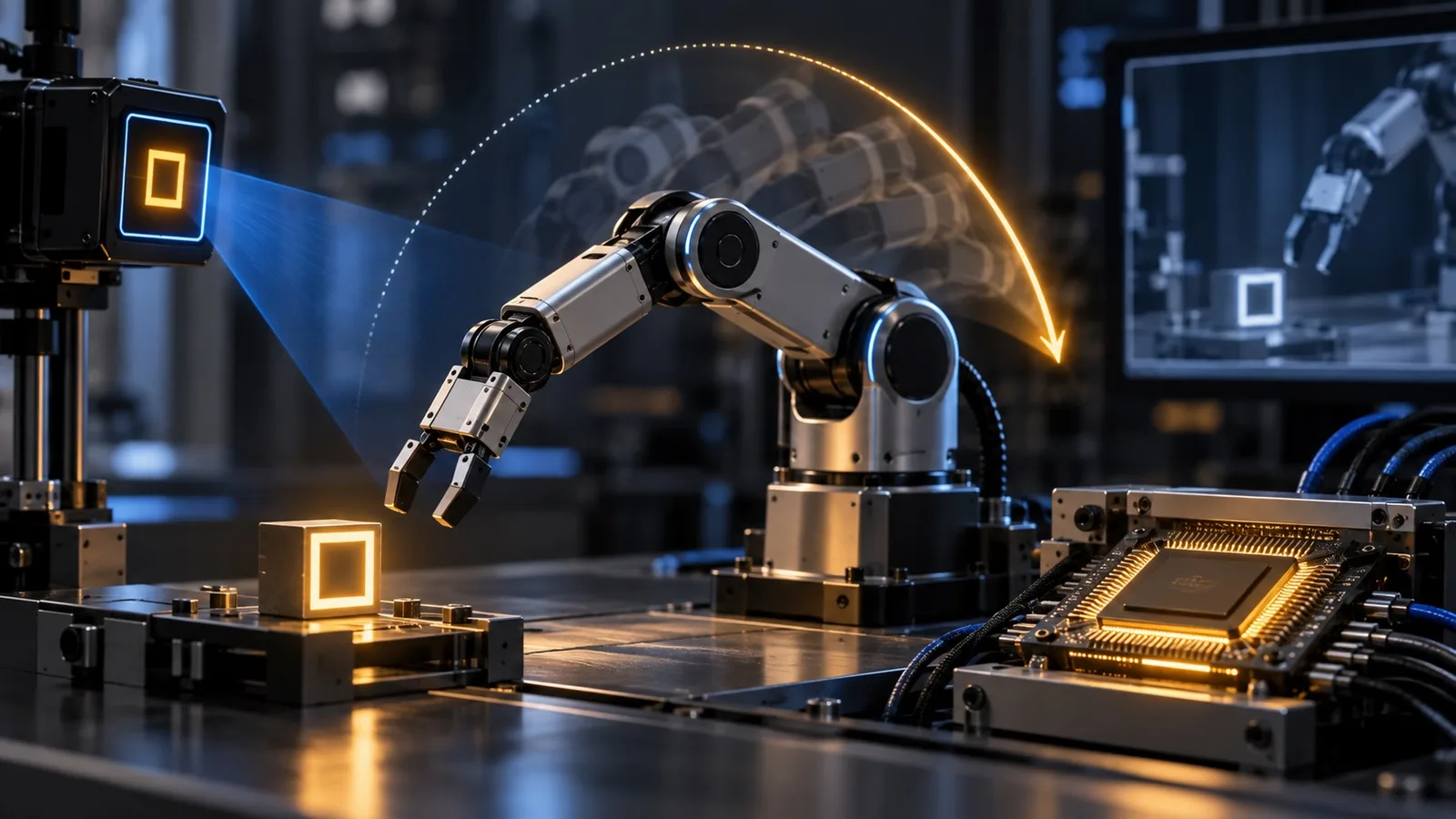
Nota used a six-degree-of-freedom SO-101 robot arm running at 30 hertz. The model does not calculate every motor step separately. It observes the scene and emits a chunk of around one second of motion.
In a synchronous system, the arm stands still while the next chunk is computed. Nota set a real-time target between 320 and 400 milliseconds after comparing the visible idle time with a GPU-based reference. At 800 milliseconds of inference, the arm would be idle for 43 percent of each cycle.
The team first optimized MolmoAct2 on Qualcomm's IQ-9075. A custom runtime split the vision encoder, language model and action head across multiple NPU cores. Graph changes cut the initial cycle from 3,681 milliseconds to 1,173.9 milliseconds, but that was still far above the target.
The model architecture became the bottleneck
Profiling showed that even removing the language-model segment entirely would leave about 415 milliseconds for the vision encoder and action head. More compression could not solve a structure that produced too many small serial operations.
Nota then screened 12 candidate backbones and ran five on the same board. GR00T N1.7 was not the raw latency winner, but it combined acceptable speed with an 80 percent real-hardware success rate before final optimization. The company reports a sevenfold speedup in simulation while keeping success at 92 percent versus 93 percent.
The final 230-millisecond figure is a company-reported engineering result on one arm, board and task. It does not establish equivalent performance across robots or environments.
Robot economics moves to the edge
Replacing a GPU module with an integrated NPU can reduce cost, power consumption and cooling hardware. Those differences matter when a company deploys hundreds of mobile robots or asks a humanoid to carry its own battery.
The experiment also carries a broader lesson for edge AI: the best cloud model may be the wrong starting point. Nota gained more by choosing a backbone compatible with caching, pruning and step distillation than by forcing the original model through another round of optimization.
Physical AI will not scale on benchmark accuracy alone. The model has to fit inside the machine's power, heat and timing budget, and sometimes that budget chooses the architecture.
Sources
- Running VLA Without a GPU: 1.6s to 230ms on a Qualcomm NPUNota AIprimary source