Indonesia is fine-tuning Google's MedGemma on its own chest X-rays for TB screening
A Google Research post says Indonesia's health ministry is adapting open MedGemma and MedSigLIP models on local data, as it aims to screen 50 million people a year.
OddBrief EditorialAI-assisted, human-reviewed
 AI
Key facts
- Who
- Indonesia's Ministry of Health, using Google's open MedGemma and MedSigLIP
- Goal
- screen 50 million citizens for TB every year
- Data
- models run locally so patient data stays in Indonesia
- Missing
- no accuracy figures for the Indonesian fine-tuning
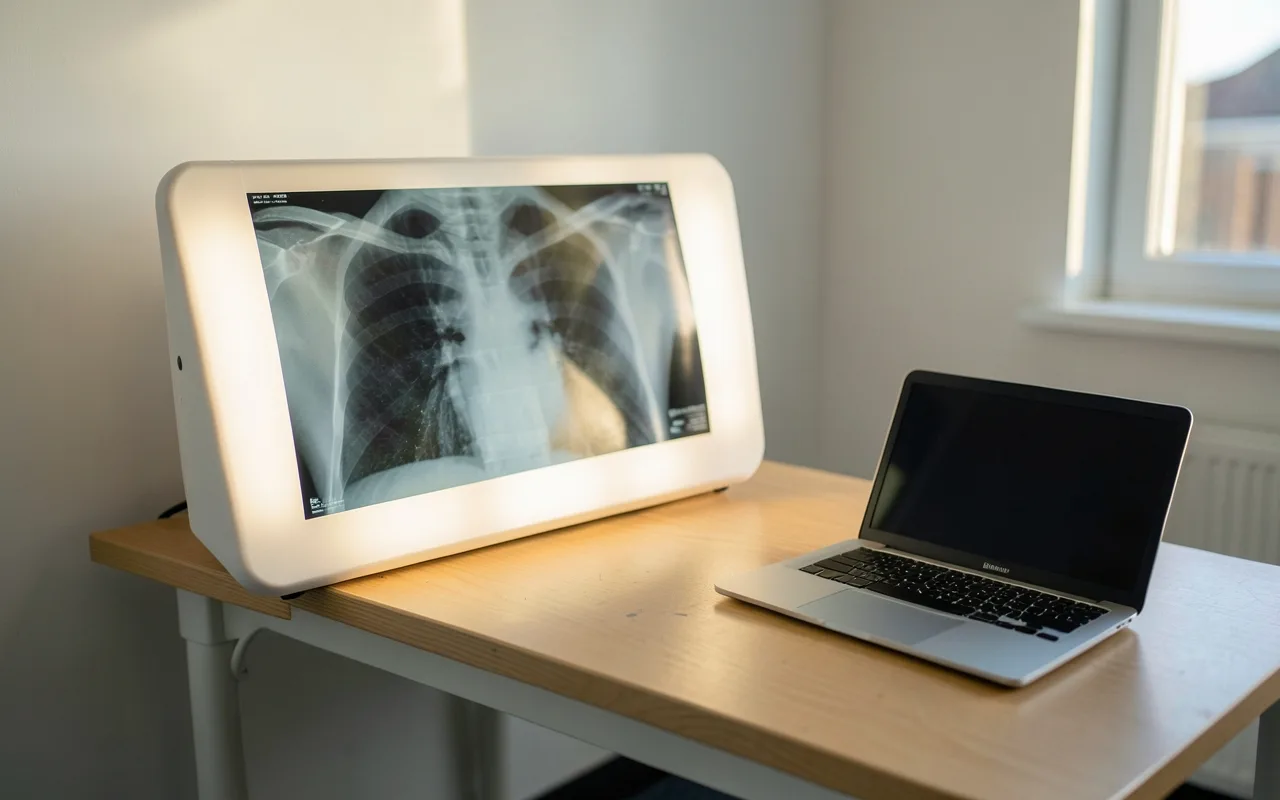
Indonesia's Ministry of Health is fine-tuning Google's open medical models, MedGemma and MedSigLIP, on the country's own chest radiographs as part of a push to screen 50 million citizens for tuberculosis every year, according to an October 23 Google Research blog post. The models run on local infrastructure so patient data stays inside the country.
The detail is a small paragraph in a longer post timed to the IDWeek 2026 conference, but it shows a national health system building on open-weight models rather than buying a finished product. Indonesia has the second-highest TB burden in the world, the post notes.
Why open models matter here
MedSigLIP is a lightweight vision-language model that links medical images such as chest X-rays to plain-language labels, so developers can classify or search images, or fine-tune with a small set of local examples. MedGemma is a family of open-weight multimodal models in 4 billion and 27 billion parameter sizes that can combine imaging findings with clinical history and run on a device without internet access.
Google says MedGemma has passed 10 million downloads since launch. The post does not give any accuracy figures for the Indonesian work, and does not say when screening with the adapted models might begin.
The commercial track runs in parallel
The same post updates a separate, older line of work: a TB detection model that Google has developed since a 2019 benchmark in Radiology, now sold by Nexus AI, a medical technology company based in Pretoria.
According to Google, the Nexus AI tool is used in about 40 health facilities. Three countries use it today (South Africa, Côte d'Ivoire and Sierra Leone), and Google says rollouts are underway in Zambia, Cameroon and the Democratic Republic of the Congo. More than 90 clinicians have used it on over 25,000 chest X-rays, and the post says it cuts turnaround from weeks to under 45 seconds. The tool carries a CE MDR Class IIb certification in Europe; WHO prequalification and US FDA clearance are still in progress.
These usage numbers come from Google and its partners, not an independent evaluation. The post describes earlier peer-reviewed validation, including a 2024 prospective study in NEJM AI that it says showed high sensitivity, but it does not quote sensitivity or specificity values.
Listening for coughs
Google also points to HeAR, an audio model trained on more than 300 million audio segments, which partners in Zambia and Ghana are testing for TB triage from cough recordings made on ordinary smartphones. The post says those groups are still building the clinical evidence, so cough screening is not yet a validated tool.
The open question is the one the post leaves out: how well the models perform once tuned on Indonesian X-rays, and whether that result will be published.
Sources
- Bringing foundational models to the front lines of TB screeningGoogle Researchprimary source