PhotoTat tattoo inks stay invisible until UV light turns them blue, magenta or yellow
CU Boulder engineers made switchable tattoo inks aimed at hidden medical markers. The inventor tried them on his own leg, but safety in people is untested.
OddBrief EditorialAI-assisted, human-reviewed
 Tech
TechKey facts
- Who
- Carson Bruns and colleagues, University of Colorado Boulder
- What
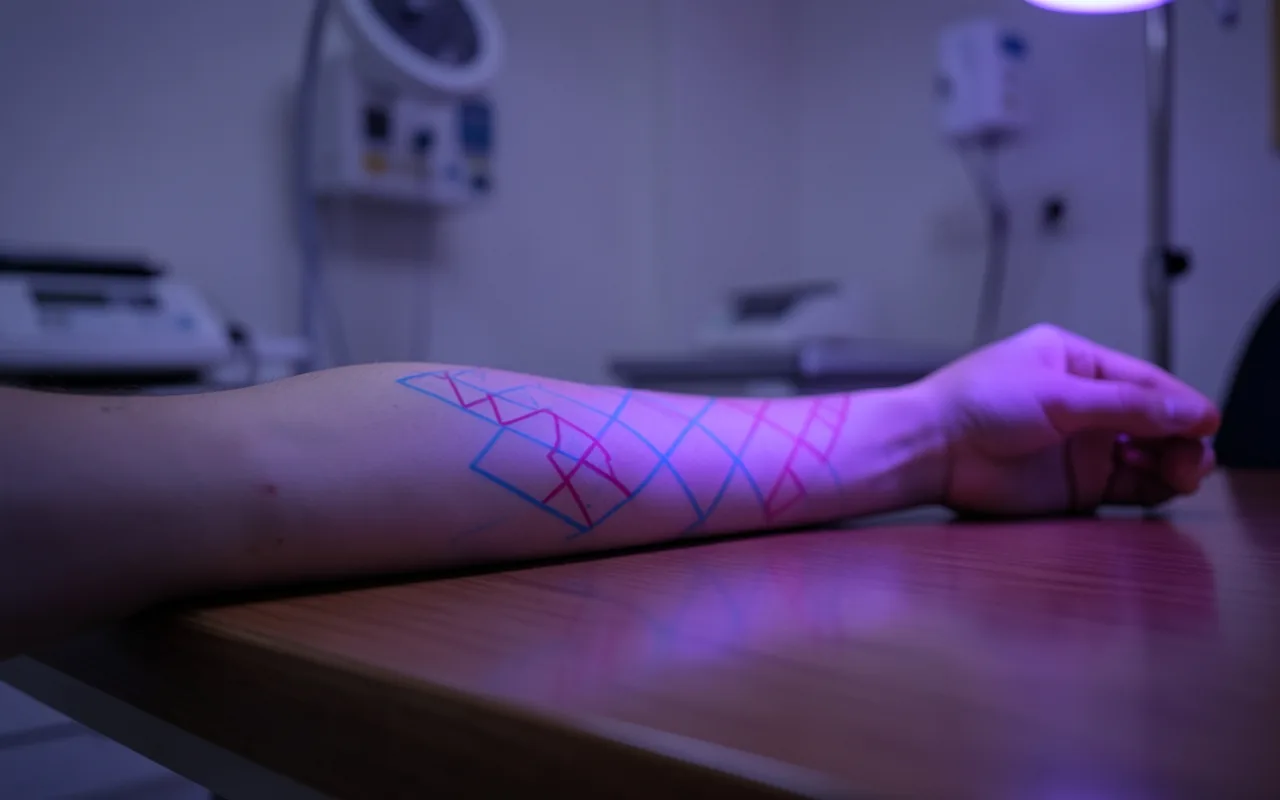
- PhotoTat inks turn blue, magenta or yellow under UV light within seconds
- Off switch
- colors fade over hours, or faster under bright LED light
- Caveat
- safety in people has not been determined
Engineers at the University of Colorado Boulder have made tattoo inks that stay invisible until ultraviolet light switches them on, according to a paper published October 9 in Matter & Light. The inks, called PhotoTat, turn blue, magenta or yellow within seconds and can be mixed into full-color images.
The most practical use the team describes is not cosmetic. It is the small permanent dots that guide radiation therapy for many cancer patients, which could be made visible only in the clinic.
Dye inside plastic beads
PhotoTat pairs photochromic dyes, which change color under light, with polymethyl methacrylate, or PMMA, a plexiglass-like material already used in medical products such as dermal fillers. The PMMA forms tiny spheres that hold the dyes.
Without UV light, the inks are invisible. After switching on, the colors fade over several hours, or faster under a bright LED light, which turns the tattoo back off. Lead researcher Carson Bruns compares it to a switch you can flip off "when you go to grandma's house."
The case for hidden medical marks
Radiation therapy often requires small tattoos so that staff can line up the beam in the same place each session. Bruns notes that these marks stay for life: "They're not beautiful, and they become a permanent reminder of a traumatic experience." An ink that appears only under a UV lamp could give clinicians the guide without leaving a visible mark.
That use is still an aspiration. The paper is a laboratory study, and according to the release, nobody has yet established whether the inks are safe in human skin.
Tested on one leg
The only human test the release mentions is on Bruns himself: he used the new ink to fill in a fish-scale design, outlined in black, on his own leg. That is a demonstration, not a clinical trial.
The research was funded in part by HYPRSKN Inc., alongside the National Science Foundation and CU Boulder's College of Engineering and Applied Science. Highsnobiety reported earlier that Bruns and tattoo artist Keith McCurdy founded HYPRSKN, which announced a single-color, magenta UV-switchable ink called Magic Ink for bookings at a New York studio. The release says PhotoTat itself is not available at any tattoo parlor yet.
What the new paper adds is color: three switchable primaries that can be combined. What it does not yet answer is how the inks behave in skin over years, and whether they are safe enough to leave there.
Sources
- Invisible tattoos that appear with lightCell Press via EurekAlertprimary source