Twenty-five Fields medalists say AI is solving math the wrong way
The mathematicians warn that treating major proofs as AI benchmarks could produce answers faster while eroding understanding and attribution.
OddBrief EditorialAI-assisted, human-reviewed
 Science
Key facts
- Who
- 25 initial signatories, all Fields medalists
- Claim
- AI benchmark incentives are misaligned with mathematical research
- Risk
- rushed proofs, weak attribution and an overload of results
- Next
- the declaration is open to more signatures
Twenty-five Fields medalists issued a joint warning on September 11 that the race to make artificial intelligence solve famous mathematical problems is working against mathematics itself. Their argument is not that machines should stay out of the field, but that solving a problem is only a proxy for the deeper goal of understanding it.
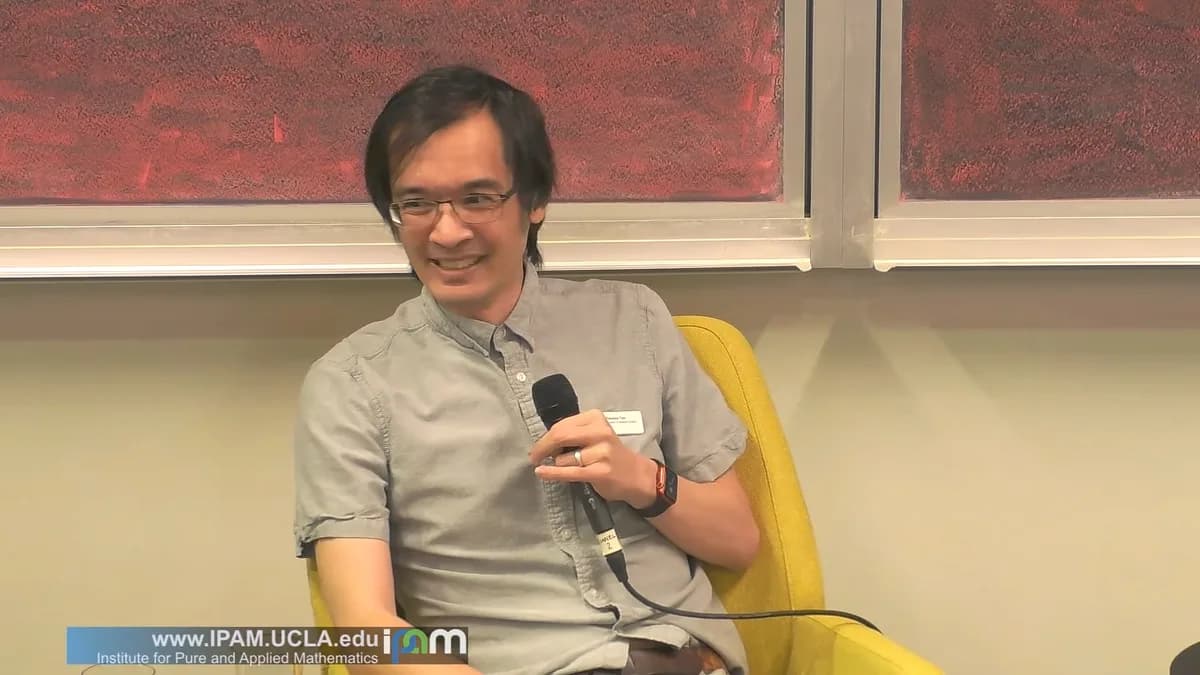
The declaration was published by mathematician Terence Tao, one of its signatories, after discussions among the group. It describes a "severe misalignment" between the incentives of AI companies and those of the mathematical community.
A proof is not the finish line
Famous unsolved problems act as landmarks for mathematics. A successful proof can introduce methods that researchers then test, simplify, teach and connect to earlier work over years or decades.
The signatories say AI companies increasingly treat those same problems as benchmarks. That rewards the moment a model produces a correct answer, even when the route to it has not been carefully written, checked or placed in context.
All 25 initial signatories are Fields medalists, including Artur Avila, Manjul Bhargava, June Huh, James Maynard, Peter Scholze, Terence Tao and Maryna Viazovska. The Fields Medal is one of mathematics' highest honors.
Too many answers can destroy the questions
The declaration warns that mass-producing true-or-false mathematical statements could exhaust what it calls the field's "fertile ground." Problems are not merely obstacles waiting to be cleared. They are also tools for training students, organizing research programs and revealing which concepts are still missing.
A flood of machine-generated results could create a second problem: human mathematicians would still have to verify, explain and integrate them. If results arrive faster than the community can absorb them, the bottleneck moves from discovery to comprehension.
The group also raises attribution and plagiarism concerns. Rushed announcements may fail to identify earlier ideas or explain which part of a result is genuinely new, especially when a model has learned from a large body of published human work.
The warning is broader than mathematics
The signatories do not reject AI. They say it could accelerate genuine study and improve understanding if its use is shaped around those goals.
Their concern extends beyond proofs. Training in science and creative work often develops judgment and the ability to ask new questions, not just the ability to deliver a final product. A system optimized only for output can appear to complete the work while bypassing the reason people valued the process.
The declaration is open to additional signatures. What remains unresolved is who gets to decide which mathematical problems should become model benchmarks, and how the people doing the downstream checking will be credited and supported.
Sources
- A Severe Misalignment of AI in MathematicsTerence Taoprimary source
- Declaration on AI and mathematicsMath and AI