Graphene’s sharpest wrinkles act like rows of tiny batteries
Researchers report experimental evidence that atom-scale bends in graphene separate charge, producing an unusually strong flexoelectric effect.
OddBrief EditorialAI-assisted, human-reviewed
 Science
Key facts
- Material
- Single-layer graphene
- Effect
- Bending separates electrical charge through flexoelectricity
- Scale
- Polarization reported 100,000 to 10 million times stronger than larger systems
- Driver
- Wrinkle sharpness matters more than height
- Status
- Experimental evidence published in Advanced Materials
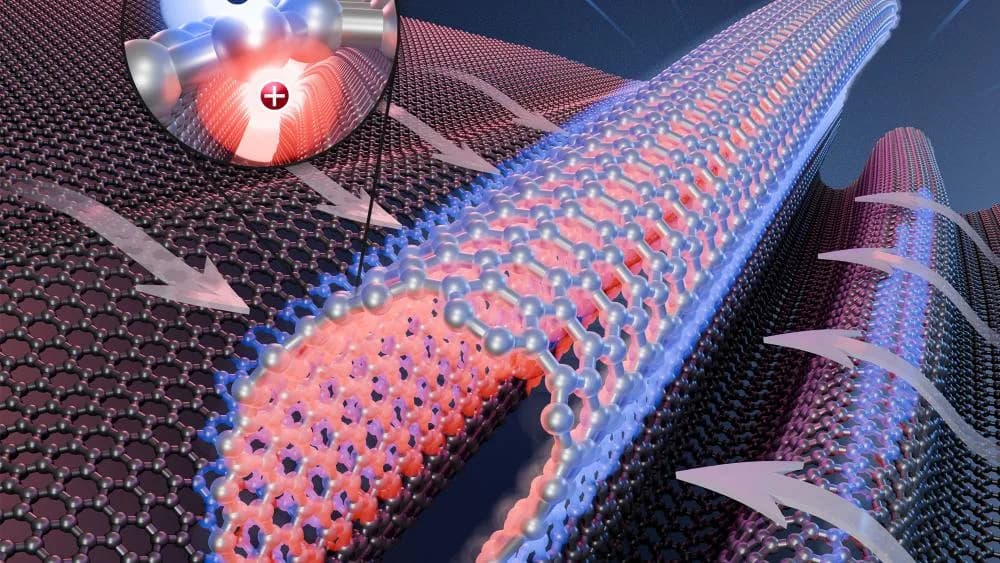
A wrinkle only a few atoms wide can make graphene behave like a row of tiny batteries. Researchers from Penn State and Rice University say they have measured flexoelectricity in one-atom-thick graphene, confirming a prediction made nearly two decades ago.
Flexoelectricity occurs when bending a material separates positive and negative charge. The effect appears in many substances, but graphene's extreme thinness lets a very small curve create a very large electrical gradient.
Sharpness matters more than height
The researchers examined narrow wrinkles in graphene with specialized microscope probes and Raman spectroscopy. They found that the electrical response depended primarily on how sharply the sheet bent, rather than how tall the wrinkle became.
Each curved region developed a polarization that acted like a microscopic voltage source. The team reports that the response was between 100,000 and 10 million times stronger than flexoelectric effects measured in thicker systems. Applying around one volt was enough to produce a detectable current along the wrinkled structure.
Those figures describe a carefully controlled experiment, not a ready-made power device. The current is small, and converting isolated wrinkles into a durable circuit would require precise control over graphene's shape and contacts.
A twenty-year prediction gets a laboratory test
The idea that graphene should become strongly polarized when bent emerged from theoretical work around 20 years ago. Demonstrating it experimentally has been difficult because the relevant features are tiny and other electrical effects can imitate the signal.
The team combined local probe measurements with spectroscopy and computational modeling. Penn State's Roar supercomputer helped connect the observed charge pattern to the shape of each wrinkle. The agreement among the methods supports the conclusion that bending itself produced the polarization.
The paper appears in Advanced Materials. As with any new materials result, independent replication will be needed, especially across different graphene samples and fabrication methods.
Electronics built from shape
Graphene is famous for strength, conductivity and a single-atom profile. Flexoelectricity adds another possible design tool: engineers might tune electrical behavior by folding or wrinkling the sheet instead of changing its chemistry.
Potential applications include ultra-small sensors, mechanically controlled switches and energy harvesters that convert vibration into current. The strongest opportunity may be in systems where graphene already serves as a membrane and its unavoidable wrinkles can become functional features.
There is also a caution in the result. Nanoscale devices often assume a slightly uneven graphene layer behaves like a flat conductor. If sharp bends generate local electric fields, wrinkles may alter performance in ways designers have overlooked.
The work turns a familiar defect into a possible component. A crumple in an atomic sheet is not merely geometry; at the smallest scale, it can rearrange the charge around it.
Sources
- Tiny wrinkles bend physics and change how electricity moves through graphenePenn Stateprimary source