A rigid film insulates five times better than silicone
Researchers built a dense perovskite coating with thermal conductivity near 0.04 W/mK while remaining thousands of times stiffer than common silicone insulation.
OddBrief EditorialAI-assisted, human-reviewed
 Science
Key facts
- Material
- 2D hybrid organic-inorganic perovskite thin film
- Thermal conductivity
- About 0.04 W/mK at room temperature
- Comparison
- Roughly five times lower than silicone
- Stiffness
- Elastic modulus measured at 7.7 GPa
- Caveat
- Lead content and long-term durability require evaluation
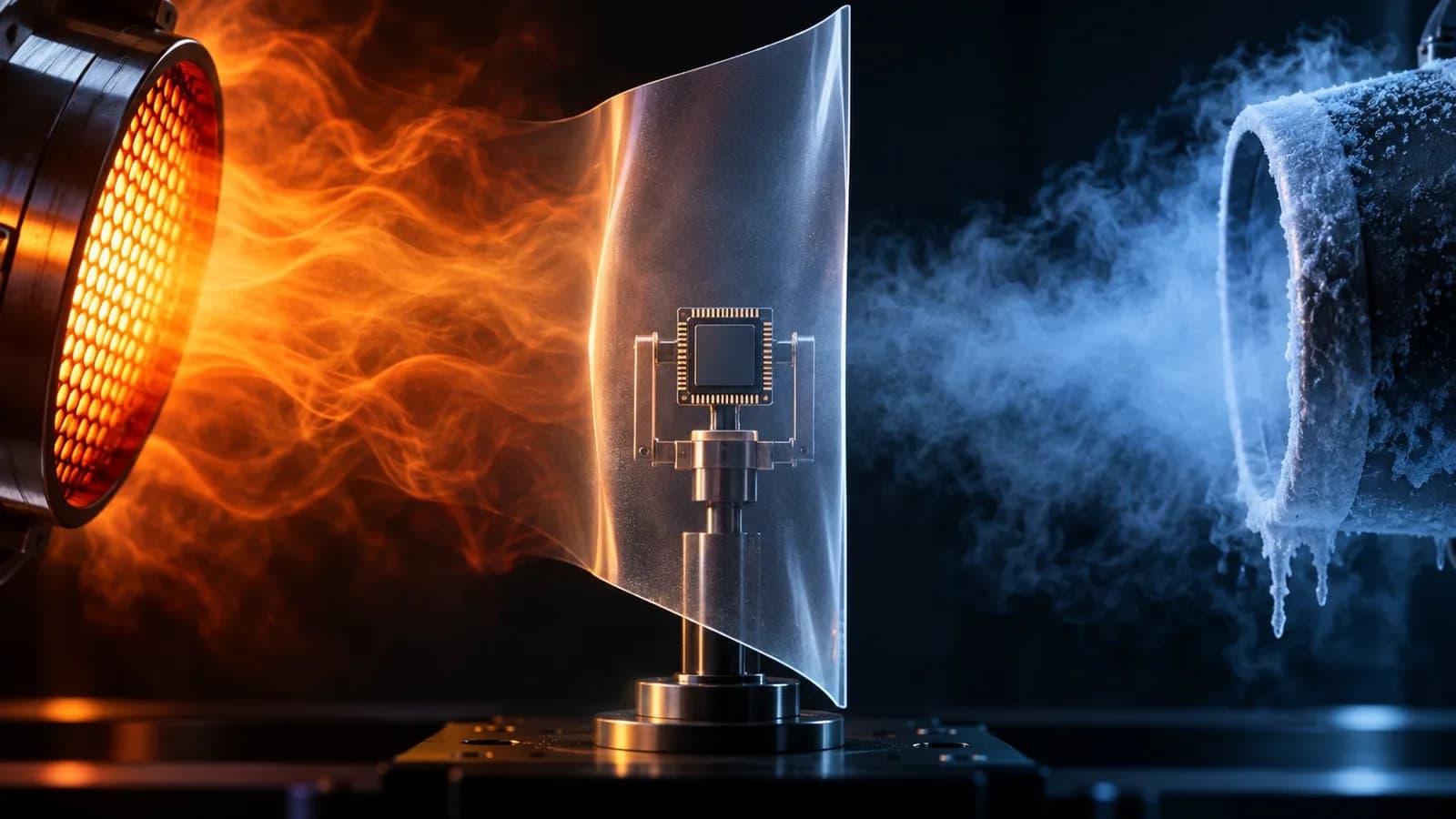
A thin, rigid coating developed by researchers at North Carolina State University combines two properties that usually pull in opposite directions. It blocks heat about five times better than common silicone insulation while remaining thousands of times stiffer.
The material is a dense, nonporous hybrid organic-inorganic perovskite made from azobenzene ethyl ammonium lead iodine. At room temperature, the team measured thermal conductivity of roughly 0.04 watts per meter-kelvin. Silicone, a widely used thermal barrier, is closer to 0.2.
Insulation without softness
Good thermal insulators often rely on pores or flexible polymer chains that slow the movement of heat. Those structures can compress, tear or lose shape, limiting their use around delicate electronics and in tight mechanical systems.
The new film takes a different route. Its layered molecular structure disrupts the vibrations that carry heat through a solid, even though the material itself is compact. The researchers report an elastic modulus of 7.7 gigapascals, making it about 700 to 10,000 times stiffer than silicone depending on the comparison material.
That combination could let a coating separate hot and cold components without adding a soft spacer. Possible uses include microelectronics, sensors and systems where a fraction of a millimeter matters.
A coating that can be spun on
The team produced the film with a spun-cast process, a technique already used to spread uniform layers across wafers and other flat surfaces. A liquid precursor is placed on a rotating substrate, and centrifugal force distributes it into a thin coating as the solvent evaporates.
That does not make the material production-ready, but it gives the work a plausible path beyond a hand-built laboratory sample. Future studies will need to test large-area uniformity, adhesion, humidity resistance and repeated heating cycles.
The lead in the formulation also creates a serious constraint. Any commercial use would need controls for manufacturing, disposal and possible exposure. The research paper demonstrates thermal and mechanical performance, not a complete environmental or safety case.
Heat is becoming a design limit
As chips and batteries pack more power into smaller spaces, moving heat has become one of the hardest engineering problems. Most work focuses on conducting heat away. Selective insulation is equally important when one component must stay hot or when a sensitive region needs protection from a nearby source.
The result, published in Science Advances, offers a new point in the material-design space: a barrier that behaves more like a structural film than a cushion. The next question is whether its record laboratory numbers survive the messy conditions of real devices.
Sources
- New material is extreme thermal insulatorNC State Universityprimary source