A bone marrow chip lets scientists watch immunity settle in
A linked lymph-node organoid and vascularized bone-marrow chip reveals how long-lived antibody-producing cells migrate and survive.
OddBrief EditorialAI-assisted, human-reviewed
 Science
Key facts
- What
- a linked lymph-node organoid and bone-marrow-on-a-chip
- Cells
- human B cells developed into antibody-secreting plasma cells
- Size
- a 3-by-5-inch stack of 96-well plates
- Study
- published in Science Advances
An NIH-funded team has connected a lymph-node-like organoid to a vascularized bone-marrow chip, creating a laboratory model that shows how human antibody-producing cells migrate, mature and survive. The system offers a view of a process that has been difficult to observe directly inside living people.
The research, announced by the National Institutes of Health on September 11 and published in Science Advances, focuses on plasma cells. These cells can remain in bone marrow and maintain antibody production after an infection or vaccination.
Two artificial tissues act as one system
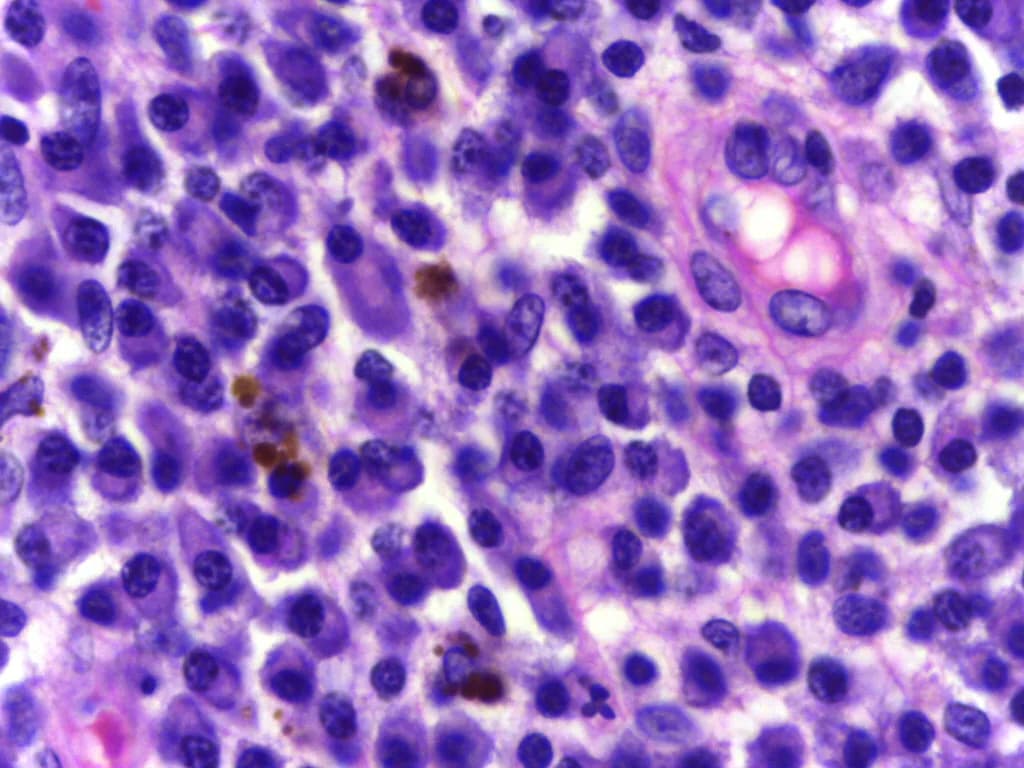
The team first grew a human lymphoid organoid using B cells isolated from tonsil tissue and blood. Researchers exposed the organoid to inactivated influenza virus, prompting the B cells to develop into antibody-secreting plasma cells.
A second laboratory built a bone-marrow chip around a microfluidic network. Channels carry nutrients and growth factors through a gel-like material designed to reproduce important parts of the marrow environment.
Connecting the two systems allowed scientists to follow cells as they left the lymphoid tissue and entered the simulated marrow. That transition helps address a basic unanswered question: why cells ready to make antibodies relocate from lymph nodes and the spleen to take up long-term residence in bone marrow.
The marrow is made of neighborhoods
Bone marrow is not a uniform container. It includes specialized niches that give cells different signals.
The chip reproduces an endosteal subniche near the outer edge of the marrow cavity, where plasma cells can be stored, and a perivascular subniche around blood vessels, where they can proliferate and activate. Imaging through the chip lets researchers track how cells respond to signaling proteins in those different environments.
The complete device fits inside a three-by-five-inch stack of 96-well plastic plates. Each plate is less than half an inch thick, turning a hidden biological process into something that can be repeatedly observed and tested on a laboratory bench.
A model, not a miniature person
The researchers stress that the chip cannot reproduce the full complexity of a human body. Its value comes from simplifying selected structures and functions while retaining enough of the original biology to ask controlled questions.
Plasma cells are protective when they produce useful antibodies. When that process goes wrong, they can contribute to allergies and autoimmune disease, while excessive proliferation can cause blood cancers.
The platform could therefore be used to study long-term immunity and to test possible treatments across infection, allergy, autoimmunity and cancer. The immediate result is more modest but fundamental: researchers can now watch human plasma cells find and respond to marrow-like niches instead of inferring the journey only from its endpoints.
Sources
- Researchers design bone marrow-on-a-chip modelNational Institutes of Healthprimary source