Legal AI startup Harvey is now worth $15.5 billion
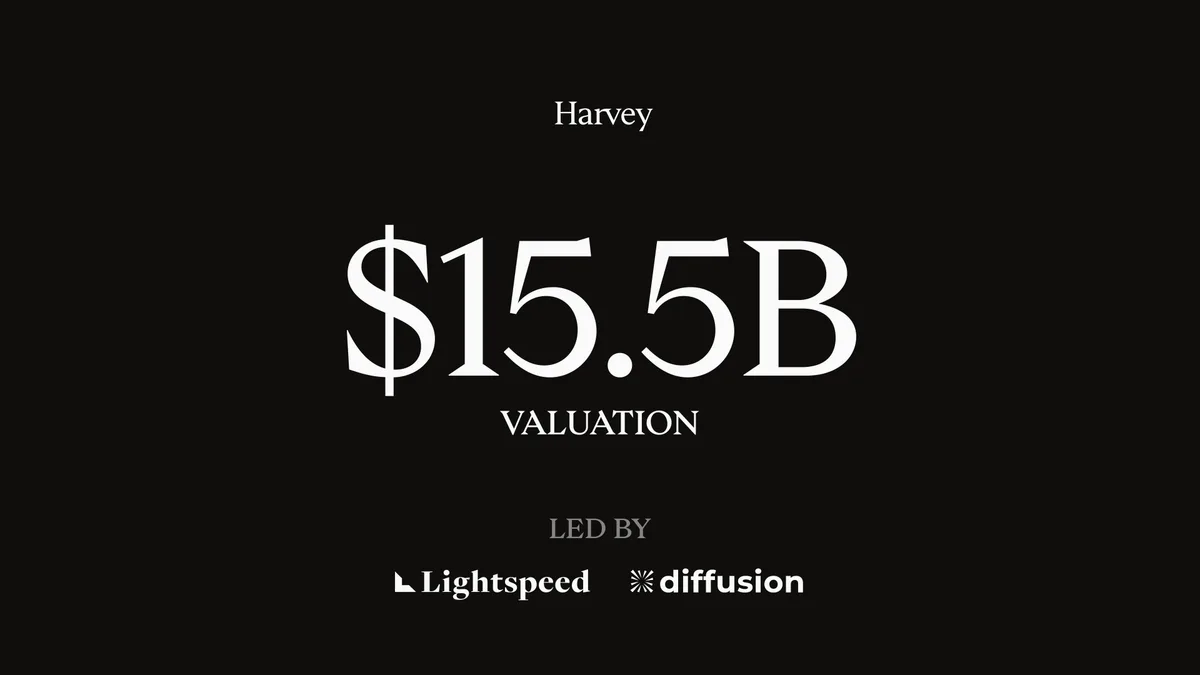
Harvey has raised $550 million at a $15.5 billion valuation as the legal AI company says its software is now used by 80% of the Am Law 100.
OddBrief EditorialAI-assisted, human-reviewed
 Business & Startups
Legal AI company Harvey has raised $550 million at a valuation of $15.5 billion.
The new financing was co-led by Diffusion and Lightspeed Venture Partners, with participation from investors including Sequoia, Kleiner Perkins, Andreessen Horowitz, Coatue and Goldman Sachs Alternatives.
Harvey builds AI tools for law firms, corporate legal departments and professional services organizations.
Legal AI has become a major business
Harvey says 80% of the Am Law 100 now use its platform.
Its customers also include legal teams at five Fortune 10 companies.
The product is designed for workflows such as legal research, document analysis, drafting and other work involving large amounts of professional information.
Harvey has expanded beyond simply providing access to general-purpose language models.
The company recently introduced its own post-trained open-weight model as well as Harvey LAB, a benchmark intended to evaluate legal agents.
The latest funding will be used to accelerate that strategy.
Why Harvey's valuation matters
Legal work has become one of the clearest early markets for professional AI.
The economics are unusually attractive.
Law firms produce and analyze enormous volumes of text, employ highly paid specialists and perform many workflows where AI can potentially reduce the time required for research and document-heavy tasks.
At the same time, legal work has a very low tolerance for hallucinations, confidentiality failures and incorrect reasoning.
That makes the sector both valuable and difficult.
Harvey's $15.5 billion valuation suggests investors believe specialized professional AI can become a large software category rather than simply a feature added to existing legal products.
The broader AI market may eventually contain fewer generic assistants and far more systems trained and evaluated around specific professions.
Law appears to be one of the first places where that transition is already producing multibillion-dollar companies.