Claude spotted a CRISPR-like pattern in phage DNA. Its function is still unknown
Anthropic says AI agents identified an unusual enzyme system and scientists tested its components, but it is not yet a gene-editing tool.
OddBrief EditorialAI-assisted, human-reviewed
 Science
Key facts
- Announced
- September 23, 2026
- Search
- about 950 agents over 21 hours
- Data
- more than 200,000 reverse transcriptases surveyed
- Finding
- array-associated reverse transcriptases in bacteriophages
Anthropic reported on September 23 that Claude agents found an unusual repeat pattern beside a reverse-transcriptase gene in bacteriophage DNA, leading its scientists to describe a previously uncharacterized enzyme system. The result is an early biological finding, not a new CRISPR treatment: the system's natural function remains unknown.
The odd pattern in a vast sequence library
Reverse transcriptases copy RNA into DNA. Researchers have cataloged many examples, including some associated with bacterial defense systems, but large sequence databases contain numerous proteins whose roles are still unclear. Anthropic's new life-sciences group asked Claude to search that material for interesting reverse-transcriptase families.
According to the company, roughly 950 agents worked for 21 hours, using about 210 million tokens. They gathered more than 200,000 reverse transcriptases, identified 3,500 candidate systems and narrowed those to 20 reports for close analysis. One agent noticed a regularly repeating stretch of DNA next to an unusual enzyme gene.
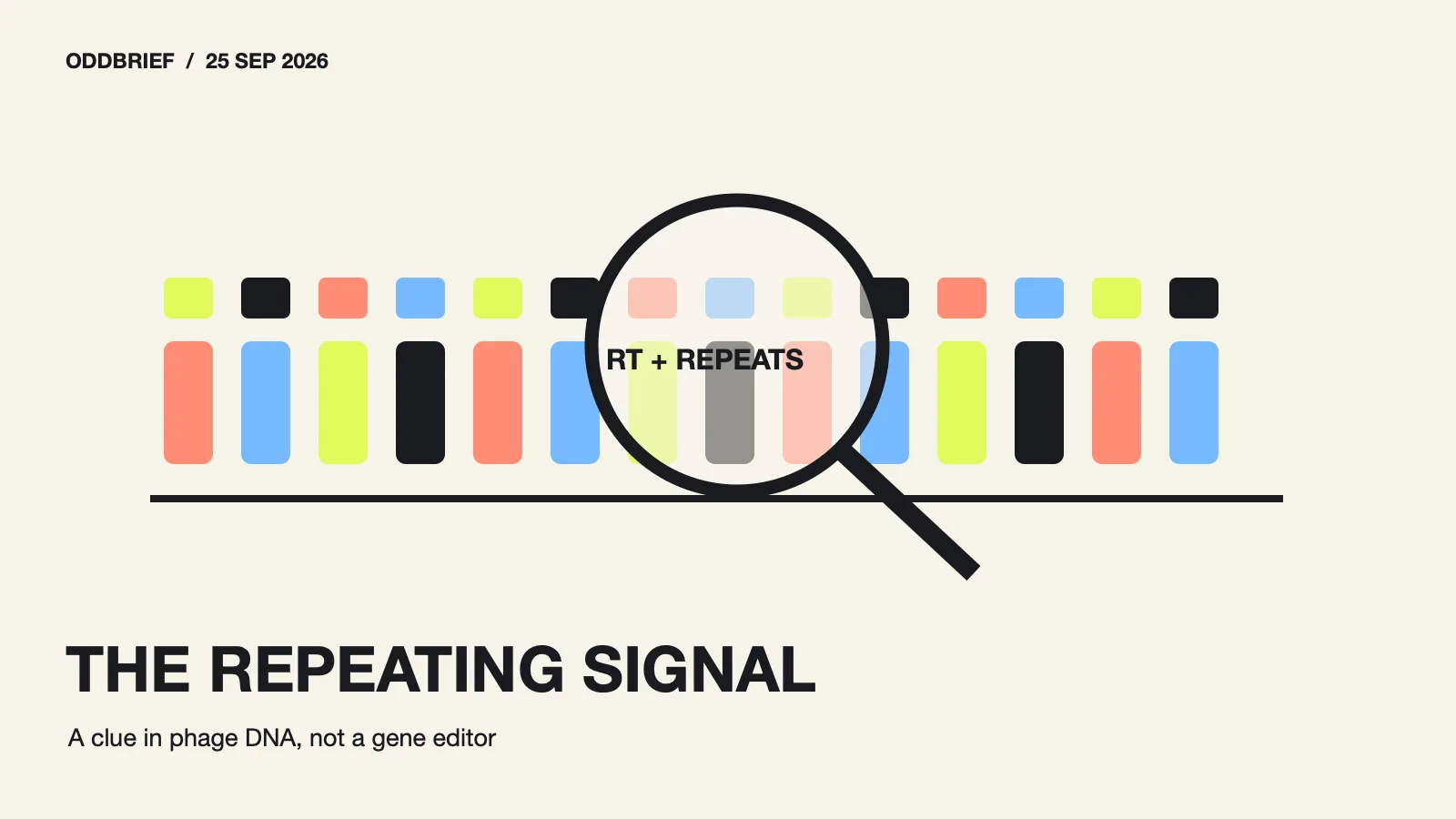
The team calls the resulting family array-associated reverse transcriptases, or ARTs. Anthropic says the arrangement has three notable parts: the enzyme, a nearby partner gene and a long array of evenly spaced repeats. Such architecture reminded the scientists of CRISPR arrays, but similarity in arrangement is a clue, not proof of equivalent function.
A human lab still has to answer why
Anthropic's researchers reviewed the agent's proposal and ran initial laboratory tests. They report that the array produces distinct short RNAs, a result that supports further investigation into how the system works. They also note that the underlying reverse transcriptase had appeared in earlier research; the claimed new insight is recognizing its associated repeat array and partner protein as a system.
The company says its laboratory work is performed by human scientists under lower biosafety levels and does not involve human-infecting pathogens. It has released a preprint with more technical detail. Preprints and company announcements provide early evidence, but the work has not established that ARTs can be programmed to cut, copy or paste DNA in a useful way.
That distinction is important because the CRISPR comparison can invite a much bigger claim than the data support. Anthropic says other systems sharing some characteristics are programmable, while explicitly stating that ART's primary function is still being studied. The finding should be treated as a biological lead, not a product announcement.
What AI actually contributed
The interesting automation here is the search strategy. Claude did not simply name a known enzyme from a prompt. The agents scanned genomic neighborhoods, compared patterns, examined literature and generated a candidate for expert review. Human scientists then decided what to test and interpreted the lab results.
Anthropic's account is its own description of an experiment inside a new company lab. Independent replication and deeper biochemical work are still needed to determine what ARTs do and whether the approach generalizes to many discoveries. For now, the concrete achievement is finding a structured anomaly in a huge database and turning it into a testable question.
Sources
- Claude discovers novel enzyme systemAnthropicprimary source