Apex Intelligence raises nearly $50M to build self-evolving foundation models for science
Beijing startup Apex Intelligence, founded June 2026 by Tsinghua's Yongchao Chen, closed angel and angel-plus rounds totaling nearly US$50 million to pursue recursive self-improvement for scientific discovery. The raise is distinct from Google's Dream-RSI research paper.
OddBrief EditorialAI-assisted, human-reviewed
 AI
AIKey facts
- Raise
- Nearly US$50M across angel and angel-plus rounds (PR Newswire, Sep 16–17)
- Leaders
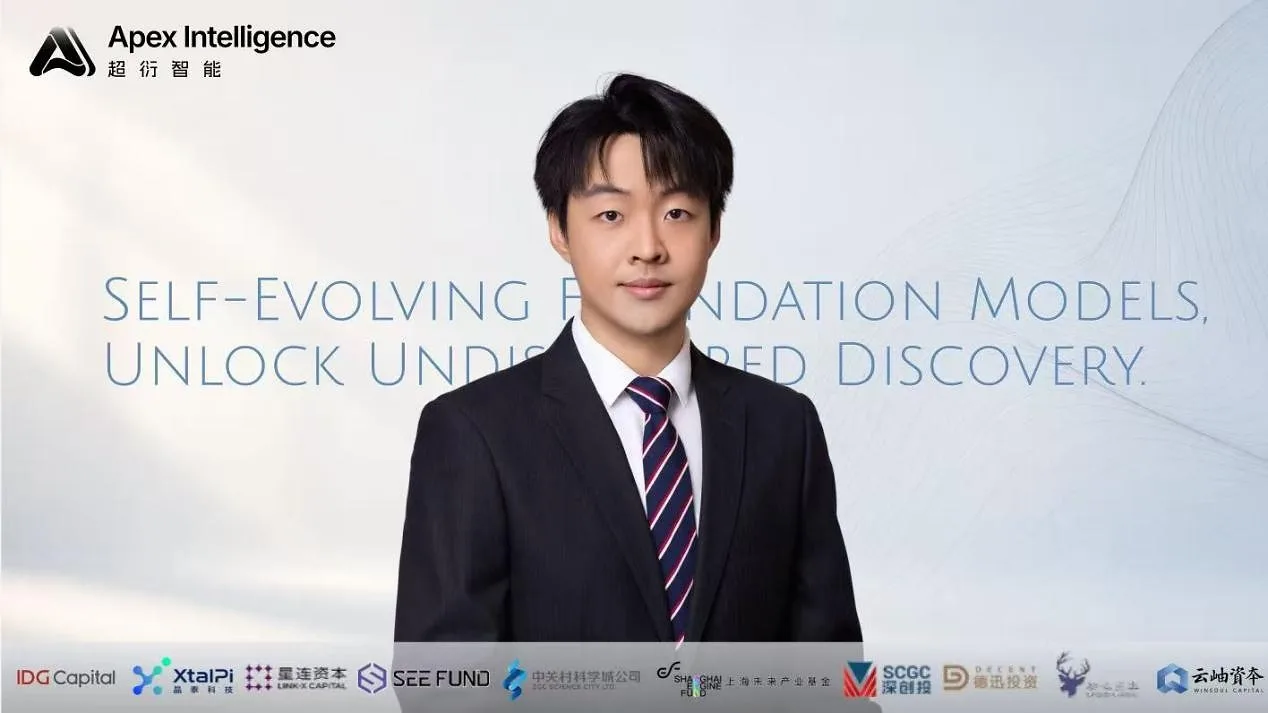
- Angel co-led by IDG Capital, LinkX Capital, XtalPi; angel-plus co-led by Zhongguancun Science City Fund, SCGC, Shanghai Engine Fund
- Founder
- Yongchao Chen, assistant professor at Tsinghua Institute for AI; USTC BS, Harvard–MIT joint PhD
- Focus
- Recursive self-improvement (RSI) foundation models aimed at scientific research, not the Google Dream-RSI paper
Apex Intelligence has raised nearly US$50 million across angel and angel-plus rounds to build self-evolving foundation models aimed at scientific research and discovery, the Beijing startup said in a PR Newswire release dated September 16, 2026. The angel round was co-led by IDG Capital, LinkX Capital, and XtalPi, with participation from Decent Capital, SEE Fund, Monad Ventures, and Winsoul Capital. The angel-plus round was co-led by Zhongguancun Science City Fund, SCGC, and Shanghai Engine Fund. Founded in June 2026, the company is entering the commercial race around recursive self-improvement, or RSI, and should not be confused with Google's separate Dream-RSI research paper already covered elsewhere.
From AI assistant to AI co-researcher
Apex frames self-evolution as models that improve themselves. Its stated goal is to move AI from an assistive tool that accelerates known work to a co-researcher that helps discover unknown directions. The company says mid-training and post-training should push models through a full cycle of hypothesis, experimentation, validation, and iteration rather than stopping at better autocomplete for engineers.
Longer term, Apex says it wants self-evolving foundation models whose collective research capability matches and eventually surpasses that of 100,000 top-tier AI scientists across disciplines. That is a vision statement, not a shipped result. Nearer-term application areas named in the release include chip design and simulation, molecular R&D, and quantitative strategy iteration: domains where R&D workflows can be structured, outcomes measured, human expertise is scarce, and trial-and-error is expensive.
Founder pedigree and claimed early results
Founder Yongchao Chen is an assistant professor at Tsinghua University's School of Artificial Intelligence. His education spans the University of Science and Technology of China and a joint Harvard–MIT doctorate, and he has researched at Google DeepMind, Microsoft, and the MIT–IBM Watson AI Lab. The core team, per the release, draws from Tsinghua, Peking University, Harvard, and MIT. From September 17 to 23 the company plans campus visits at Harvard, MIT, Yale, and Boston University for recruiting and research collaboration.
In its own benchmarks narrative, Apex says its system has produced AI-for-AI research of a standard suitable for leading conference acceptance and set or approached best publicly reported results on suites including SimpleTES, NanoChat Autoresearch, GPUMode TriMul, and MLS-Bench, outperforming solutions linked to Recursive Superintelligence, Tencent Hunyuan, Stanford, and NVIDIA in those comparisons. On the math side, it claims a complete proof of the majorization conjecture and breakthroughs in optimization theory and geometric topology. Those claims come from the company and have not been independently verified in this article.
Chen's founder quote sketches the ideological bet behind the raise: models taught only by humans stay capped by human preferences, and true intelligence ceilings must be set by the objective world. Whether nearly $50 million of angel capital can turn that thesis into durable scientific systems is the open question. The odd angle is timing and category. While Western labs publish RSI-adjacent papers, a two-month-old Beijing startup is already raising at angel-plus scale to industrialize the same idea for science, and it wants that story heard on U.S. campuses the same week the money lands.
Sources
- Apex Intelligence Raises Nearly US$50 Million in Angel Funding to Build Self-Evolving Foundation ModelsPR Newswire via HK Businesswireprimary source
- Apex Intelligence company siteApex Intelligence